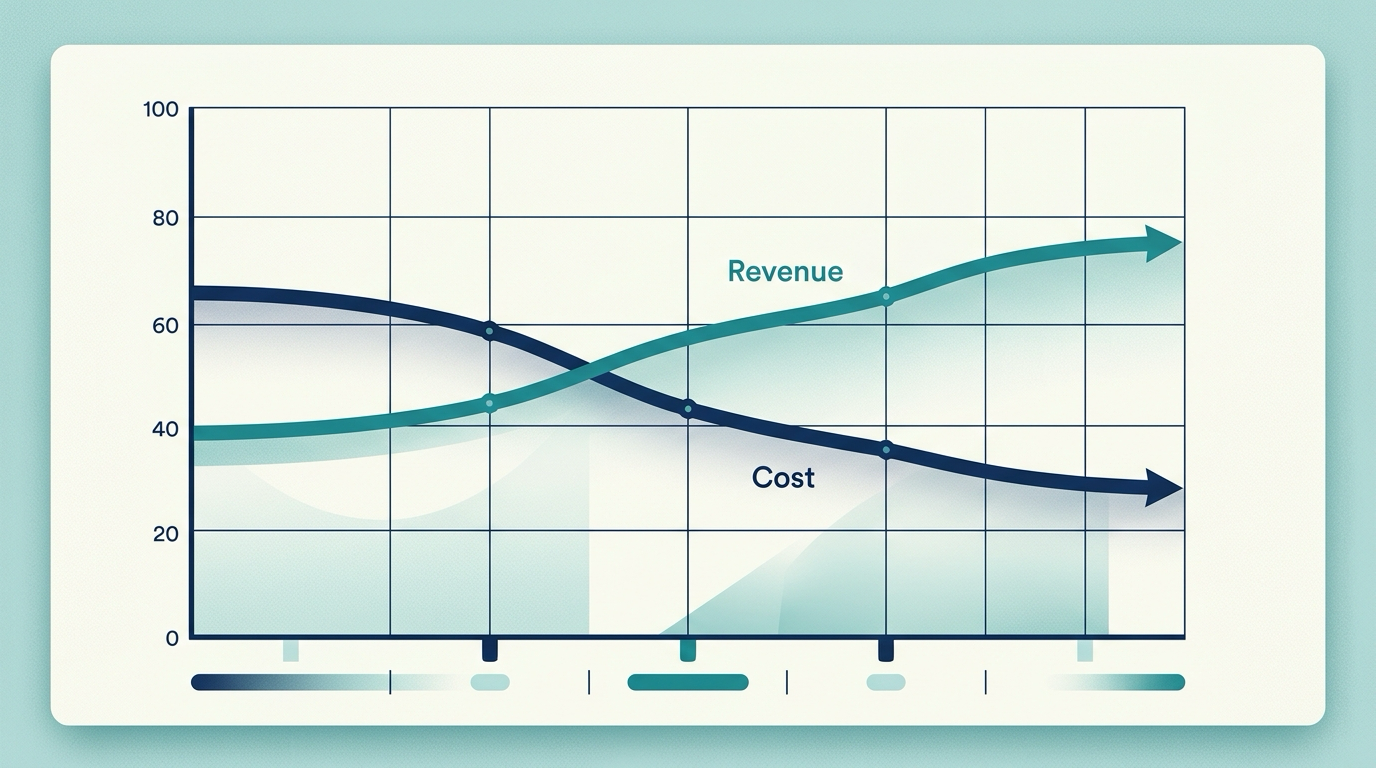
Your Meta ads CAC is going up. CPMs are rising. Conversion rate is flat or dropping. You're spending more to acquire the same customers — and the instinct is to cut budget, tighten spend, and wait for things to reset. (If your ROAS is also dropping, these two problems are almost always connected.)
That instinct is wrong, and it will make the problem worse.
Lowering CAC on Meta is not about spending less. It's about making every dollar more efficient. Those are different problems with different solutions. This guide gives you six levers to lower customer acquisition cost on Meta without cutting scale — with vertical-specific benchmarks for fashion and health brands so you know whether your number is actually a problem before you touch anything.
Key Takeaways
- Apparel & Accessories brands on Meta see a median CPA of $36.98. Health & Wellness is $40.53. If your CAC is within 30% of these numbers, you may have a margins problem, not a CAC problem.
- Meta CPMs rose 13.24% year-over-year (Aug 2025–July 2026). Rising CAC isn't always an execution failure — sometimes it's the market. Knowing the difference matters before you start optimizing.
- Pixel-only brands overstate CAC by 25-45% after iOS 14.5. Before you optimize your spend, fix your measurement.
- The fastest CAC lever is almost never creative — it's the post-click experience. A 1% CVR improvement reduces CAC by the same percentage as a 1% CPM drop.
- Cutting scale to fix CAC almost always makes it worse. Meta's algorithm needs volume to find efficient buyers. Starving it of spend is the slowest path to efficiency.
What Is a Good CAC on Meta Ads for Ecommerce?
The direct answer: your target CAC depends entirely on your vertical, AOV, and contribution margins. But you can benchmark against real data before deciding whether you have a problem.
According to Triple Whale's analysis of 40,000+ ecommerce brands across Meta from August 2025 to July 2026, median CPA by vertical breaks down as follows:
| Vertical | Median CPA (Meta) | YoY Change |
|---|---|---|
| Lifestyle & Boutique | $31.16 | +4.35% |
| Apparel & Accessories | $36.98 | +1.49% |
| Food & Beverage | $38.57 | +0.71% |
| Overall (all verticals) | $38.99 | +3.14% |
| Beauty | $39.31 | +6.06% |
| Health & Wellness | $40.53 | +8.95% |
| Sports & Outdoors | $44.53 | +1.35% |
Source: Triple Whale, Facebook Ad Benchmarks by Industry, Aug 2025–July 2026
Two things stand out. First, Health & Wellness CAC is rising faster than any other soft goods vertical — up 8.95% year-over-year. That's tracking with tighter Meta ad policies around health claims and more compliance-sensitive competition in the auction. If you run a supplement or wellness brand, benchmark pressure is structural, not just execution.
Second, Apparel is relatively stable (+1.49%). Fashion CAC is durable because the auction doesn't carry the same compliance friction. A rising CAC in fashion is almost always an execution problem — which means it's fixable.
The real question isn't whether your CAC is high. It's whether your contribution margins can support it.
A $45 CAC on a $120 AOV with 55% contribution margins is a profitable business. That same $45 CAC on a $65 AOV at 35% margins is bleeding cash. Benchmark against your vertical, then check the unit economics. If margins are healthy and CAC is near benchmark, you may not need to optimize CAC — you may need to increase AOV or improve retention instead.
Why Is Your CAC Rising on Meta? (What's Actually Causing It)
Before pulling any levers, diagnose the cause. Rising CAC on Meta comes from three distinct sources — and the fix is different for each.
CPM inflation (input cost): Triple Whale data shows Meta CPMs rose 13.24% year-over-year, from $13.30 to $15.06 per thousand impressions. This is a market-wide auction cost increase. Your creative didn't get worse — the auction got more expensive. Inflation-driven CAC requires a different response than an execution problem.
Creative fatigue (CVR-driven): Overall Meta CVR dropped 4.73% year-over-year. When creative stops resonating, click-throughs fall, cost per click rises, and CAC climbs even when CPMs stay flat. Creative fatigue is the most common fixable CAC driver and the one most brands can address quickly.
Measurement drift (attribution-driven): Pixel-only brands overstate CAC by 25-45% post-iOS 14.5, according to analysis from Eightx.co. Part of your CAC increase over the past two years may be real — and part may be your measurement getting less accurate as signal degrades. Fixing attribution can reduce apparent CAC without touching a single ad.
Knowing which one you're dealing with is the first step. Don't start with creative if the real issue is CPM inflation. Don't restructure campaigns if the problem is a broken pixel.
Why Cutting Scale Makes CAC Worse
This is the trap most brands fall into: CAC goes up, so they cut budget to preserve efficiency. The logic feels sound. It almost never works.
Meta's algorithm needs purchase volume to find efficient buyers. When you cut budget aggressively, you shrink the conversion data pool the algorithm learns from — you get fewer signals per dollar, and the algorithm defaults to safer, more obvious (and more expensive) audiences. Learning degrades. CAC tends to rise again once you restore spend, often higher than before.
The brands that consistently manage CAC well are the ones that focus on signal quality and creative velocity while keeping spend consistent. Budget cuts are the right call when unit economics are negative overall. They are not an optimization tactic.
6 Levers to Lower CAC on Meta Ads Without Cutting Scale
Lever 1: Fix Attribution Before You Optimize Anything
If you're running pixel-only tracking without server-side CAPI (Conversions API), you're optimizing against a number that's potentially 25-45% inflated. You might be cutting campaigns that are actually profitable and doubling down on ones that only look clean in Ads Manager.
The fix: implement CAPI through your ecommerce platform (Shopify has a native CAPI integration; WooCommerce has third-party connectors). Once live, cross-reference Ads Manager reported conversions against your actual backend order count for the same date range. The ratio reveals your attribution gap. Once you know the real number, you're working with real data.
This is the only "free" CAC reduction on this list. You're not spending less or changing your creative — you're removing the illusion that things are worse than they are.
Lever 2: Diagnose Creative Fatigue at the Ad Set Level
Most brands look at campaign-level ROAS to diagnose fatigue. That's too broad. A campaign can look healthy in aggregate while one ad set is running at $90 CAC and another is performing at $28. The blended number hides both.
Pull a 30-day view sorted at the ad set level. Flag any ad sets where weekly frequency climbs past ~5 and CAC is 30% or more above your target. Those are your fatigue candidates — and the fix often isn't a new creative concept. It's format rotation.
If a fatigued ad set has been running static images, test Reels-format video. If it's been running story video, try a carousel. Different formats reset the effective frequency for different audience segments because Meta treats them as distinct placements. You can extend the life of a winning creative concept by rotating format before replacing the concept entirely.
A note from our client work at Dash Activate Online: Across the fashion and health ecommerce accounts we manage, ad set-level frequency is the single most reliable early indicator of incoming CAC deterioration — more predictive than overall ROAS trends. In our Advantage+ Shopping campaigns specifically, we see a consistent pattern: once weekly ad set frequency climbs past roughly 5, CPA starts to drift upward, even while spend and creative hold steady. We don't treat it as a precise formula — there's no clean "frequency 6 equals X% CAC increase" law, and any benchmark claiming one is overfitting noise. But directionally, frequency above ~5 is our earliest signal to rotate format or refresh the concept before efficiency erodes further.
Lever 3: Consolidate Campaign Structure (The Over-Segmentation Tax)
The most common structural mistake in ecommerce accounts is over-segmentation: too many campaigns, too many ad sets, each with too little budget to learn efficiently.
Meta needs approximately 50 purchase events per week per ad set to exit the learning phase and optimize reliably. At a $40 CAC, that's $2,000 per week per ad set — roughly $8,000/month per learning pool. An account spending $10,000/month total should not be running more than one or two active ad sets if the goal is efficient learning.
When you split budget across six or eight ad sets, you're fracturing your conversion signal. Each pool gets insufficient data to exit learning, Meta makes suboptimal bid decisions for each, and your blended CAC reflects the noise.
The fix: consolidate to fewer ad sets, use Advantage+ audiences to let Meta handle signal distribution, and concentrate budget. You don't need 10 audience variants to reach your customers — you need one or two well-funded ad sets with strong creative rotation inside them.
Lever 4: Optimize the Post-Click Experience
Your CAC is a product of two variables: cost per click and conversion rate. Most brands obsess over CPCs and ignore the conversion rate side entirely.
At $1.50 CPC and 1.5% CVR, your CAC is $100. At the same $1.50 CPC with 2.5% CVR, your CAC drops to $60. That's a 40% improvement without touching the ad account.
The fastest post-click wins:
Message match: The hook in your ad should be reflected in your landing page headline within the first visible screen. When the ad promises "Swimwear that actually fits a long torso" and the landing page hero shows a generic collection page, the conversation breaks and visitors bounce. Match the promise to the page.
Mobile speed: Every additional second of load time after 2 seconds costs measurable conversion rate. Use Google PageSpeed Insights for a baseline. Any score below 70 on mobile is a CAC tax you're paying on every dollar you spend.
Social proof above the fold: Review counts, specific outcome claims, or customer numbers placed in the first screen lift conversion more reliably than any color test or layout change. For health brands especially, specificity matters — "4,800 5-star reviews" outperforms "highly rated."
Lever 5: Increase AOV to Make Your CAC Work Harder
This is the most underused lever on this list. If your CAC is near benchmark and margins are tight, the problem may not be that CAC is too high — it's that your AOV is too low.
At $40 CAC and $65 AOV, you're operating on thin margin. At $40 CAC and $95 AOV, the math transforms. Every dollar of AOV improvement is equivalent to a dollar of CAC reduction.
Practical plays that move AOV for fashion and health brands:
- Bundles at product level: "Complete the look" for apparel, "starter kit" configurations for health/supplement. Surface these on product pages, not just at checkout.
- Subscribe & Save: For replenishable health products — vitamins, supplements, skincare. A 10-15% discount for auto-ship converts well and reduces blended CAC by extending customer LTV.
- Pre-checkout upsells: Shopify One Page Checkout supports pre-cart recommendations natively. A well-placed "add $X to unlock free shipping" is one of the highest-ROI interventions you can deploy this week.
Triple Whale's data puts overall ecommerce AOV at $73.36. Brands pushing toward $90-100+ through intentional bundling shift the entire unit economics equation — the same CAC becomes sustainable at higher spend levels.
Lever 6: Feed the Algorithm Better First-Party Signals
Meta's auction algorithm learns from the signals you provide. If you're only feeding it pixel purchase events, you're giving it a partial picture of who your best customers are. Every signal improvement is a compounding efficiency gain that compounds over time.
Three signal improvements that move the needle:
Customer list suppression and seeding: Upload your existing customer list as a suppression audience (remove from prospecting) and as a lookalike seed. Your existing buyers are your best signal of who else will convert — and suppressing them from prospecting improves new customer CAC without any creative change.
High-engagement email sync: If you're on Klaviyo or a similar ESP, sync your engaged subscriber segments (opened in last 30 days, clicked in last 30 days) to Meta as custom audiences. These are warm signals. Retargeting them is cheap and effective, and using them as lookalike seeds improves prospecting quality.
Event depth via CAPI: Beyond purchase events, pass add-to-cart, initiate-checkout, and view-content events server-side. More conversion signal across the funnel means faster algorithm learning and more efficient bid decisions throughout the customer journey.
The rule is simple: the brand giving Meta the cleanest, most complete first-party signal wins the auction more efficiently than competitors relying on degraded pixel data.
How to Lower CAC While Scaling: The Compound Play
These levers work in sequence. Here's how to stack them without disrupting performance:
- Stabilize measurement first. You need a real CAC number before optimizing anything.
- Consolidate structure. Reduce to efficient learning ad set counts before increasing spend.
- Run creative velocity. Launch one new concept per week minimum. Don't wait for a full campaign overhaul.
- Run CRO in parallel. Most accounts run either ad-side tests or landing page tests. The fastest CAC drops come from both running simultaneously.
- Scale in 20% budget increments. Once CAC is stable and CVR is optimized, increase daily budgets 20% at a time with three-day stability windows between increases. This keeps the algorithm in a learning-stable state and avoids the spike that comes from aggressive budget jumps.
The brands that consistently lower CAC while growing don't do one big thing. They run a tight, ongoing system: fresh creative, clean structure, real measurement, and steady signal. That's the compounding advantage.
Frequently Asked Questions
What is a good CAC for a fashion brand on Meta ads?
According to Triple Whale's 2025-2026 benchmark data across 40,000+ brands, the median CPA for Apparel & Accessories on Meta is $36.98. Lifestyle and boutique brands tend to run lower ($31.16). High-end fashion with longer purchase consideration cycles often runs 30-50% above median. The right target depends on your AOV and contribution margins more than the benchmark number alone.
What causes CAC to spike when I scale Meta ads?
The most common cause is budget scaling faster than the algorithm can find efficient buyers. Increasing daily budgets by more than 20-30% at once pushes ad sets into a new learning phase, which inflates CAC temporarily while the algorithm re-optimizes. Scale in 20% increments with three-day windows between increases.
Does cutting Meta ad spend lower CAC?
Rarely, and usually the opposite. Reducing spend shrinks the conversion volume the algorithm learns from, which degrades efficiency over time. Cut spend if unit economics are negative overall. Don't cut it as a short-term CAC optimization tactic.
How long does it take to lower CAC on Meta ads?
Attribution fixes take one to two weeks to see clearly. Creative and landing page improvements show results in two to four weeks per test. Structural consolidation changes take two to three weeks for the algorithm to exit learning phase. Most accounts see measurable CAC improvement within four to six weeks when multiple levers are pulled simultaneously.
What's the difference between CAC and CPA on Meta?
CPA (cost per acquisition) in Meta Ads Manager is what the platform reports based on its attribution model. True CAC is what you actually spent to acquire a customer, calculated against backend order data. Due to iOS signal loss and attribution windows, these numbers often diverge by 25-45%. Use backend data for operational decisions.
If your CAC is rising and you're not sure which of these levers is the real bottleneck, that's the exact conversation a strategy call is for.
No pitch. No deck. Just a clear diagnostic on what's driving your CAC and where the fix actually lives.