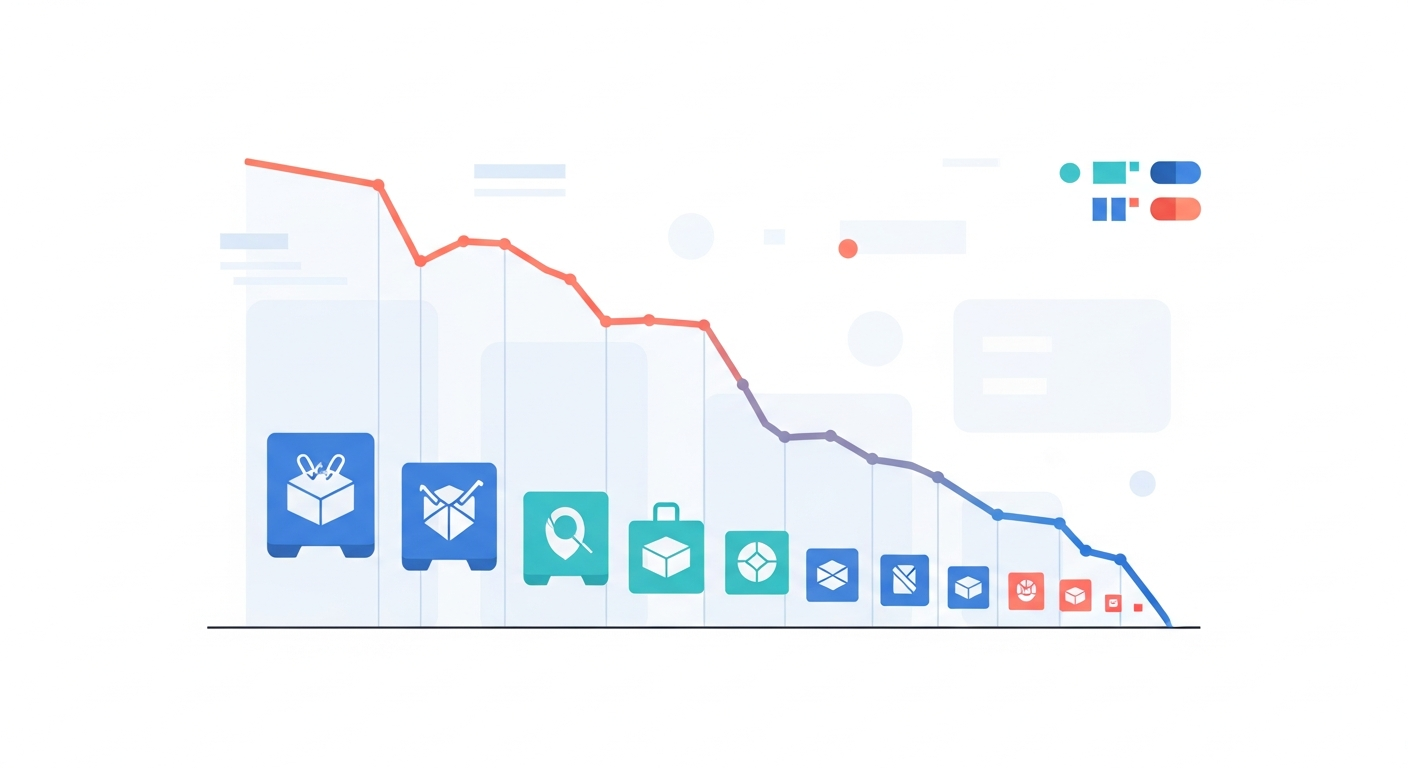
Your ROAS dropped last week. Maybe 15%. Maybe 30%.
Your first instinct was to check the algorithm. Maybe iOS. Maybe a new competitor. Maybe Meta's latest update.
Here's the more likely answer: your creative is tired.
Creative fatigue is the #1 silent performance killer for ecommerce brands on Meta Ads right now — and in 2026, it's hitting faster than ever. Meta's Andromeda algorithm burns through audience segments in 2-3 weeks. That used to take 4-6 weeks. Which means the creative refresh cadence most brands learned in 2023 is now half a cycle behind.
This guide gives you the 4 diagnostic signals to catch creative fatigue before your ROAS tells you it's happened — plus the system to prevent it from killing performance in the first place.
What Creative Fatigue Actually Is (And What It's Not)
Creative fatigue happens when your target audience has seen your ad too many times. Response drops. Click-through rate falls. Costs rise. Eventually ROAS follows.
What it's not:
- An iOS attribution problem
- A Meta algorithm change
- Seasonal softness
- A bidding issue
Most brands reach for those explanations first because they feel external — outside your control. Creative fatigue is internal. It means your content has run its course, and the fix is in your hands.
Here's what makes 2026 different: Meta's Andromeda system processes and distributes ad creative with significantly more precision than the previous algorithm. It reaches your relevant audience segments faster. Where an ad used to take 4-6 weeks to exhaust its primary audience, it now takes 2-3 weeks.
If you're running Advantage+ Shopping Campaigns (ASC), the timeline is even tighter. ASC pulls from broader audience pools and allocates budget dynamically — which means it can burn through a creative's responsive audience in under two weeks at scale.
The implication is simple: the creative rotation schedule most brands are running is already behind. And by the time ROAS shows it, you've lost margin you can't recover.
The 4 Early Warning Signals (Before ROAS Crashes)
ROAS is a lagging indicator. By the time it drops, creative fatigue has been building for days — sometimes weeks. These four signals give you an earlier read.
Signal 1 — CPMr Is Climbing
CPMr is your cost to reach 1,000 unique users. It's different from standard CPM, which includes repeat impressions to the same person.
A healthy CPMr sits below $20 for most ecommerce verticals. When it starts climbing consistently over a 5-7 day window, the algorithm is working harder to find new users who respond to your existing creative. The audience that converts on this ad is shrinking, so Meta is expanding its search — and charging you more for it.
CPMr won't show up in your default Ads Manager view. You have to add it manually: go to Columns → Customize Columns → search for "Reach" and pull in both Reach and CPM, then calculate CPMr separately (Spend ÷ Reach × 1,000). Some attribution tools (Triple Whale, Northbeam) surface this natively.
Watch for a 10-15% CPMr increase over a 7-day rolling window. That's your first signal.
Signal 2 — CTR Drops 20%+ From Its 7-Day Peak
Most brands look at CTR as a point-in-time number. The smarter read is to compare it against that ad's own 7-day peak performance.
When CTR drops 20% or more from its best 7-day average, the audience isn't gone — they're tuning out. They've seen it. The hook didn't land this time. The creative has lost its novelty.
This is a surface-level signal but it's fast. CTR drops are visible in Ads Manager within days. The mistake most operators make is waiting until CTR is visibly low — at that point, you've already wasted 5-10 days of spend.
The rule: 20% drop from 7-day peak = flag it. 30% = refresh immediately.
Signal 3 — CPA Creeps Up 15%+ From Baseline
This one is subtler, and it often arrives after CPMr and CTR have already moved.
Here's why it matters: when CPA rises while CTR still looks acceptable, it usually means the audience clicking is lower-intent. The people who were most likely to buy have already converted or scrolled past your ad multiple times. What's left are people further from purchase — they still click, but they don't convert.
Establish a 30-day CPA baseline per creative when you launch it. When you see 15% creep above that baseline without a clear external cause (price change, landing page issue, offer change), creative fatigue is the most likely culprit.
Signal 4 — Frequency Crosses 3.0 on Prospecting
Frequency is the most talked-about fatigue signal — and also the most overused as a standalone diagnostic. Meta's own data shows that ad frequency above 3.0 correlates with a measurable drop in click-through rate for most consumer categories in prospecting campaigns.
Retargeting is different. A warm audience can tolerate frequency of 8-10 before meaningful degradation. But prospecting audiences — people who don't know your brand — start tuning out fast above 3.0.
The problem with relying on frequency alone: it's a lagging signal. By the time frequency hits 3.0 in most campaigns, CPMr and CTR have already been signaling fatigue for 5-7 days. Use frequency as confirmation, not as your primary alert.
The diagnostic order: CPMr first → CTR second → CPA third → Frequency last.
Why This Is Happening Faster in 2026
The Andromeda update changed how Meta's algorithm distributes ad creative. It's not a single change — it's a system-level shift in how Meta's AI identifies and serves ads to responsive audience segments.
The short version: Andromeda is better at finding the right person for a given ad, which means it reaches your high-probability converters faster. That's good for performance in the short term. The downside is that your "addressable responsive pool" for any single creative exhausts itself faster.
Two to three weeks used to be the refresh floor. Now it's approaching the ceiling.
ASC compounds this. Because Advantage+ Shopping Campaigns consolidate targeting decisions into Meta's algorithm and draw from broader audiences, they often deliver faster early results — but also faster creative saturation. Brands scaling on ASC without a structured creative pipeline are seeing fatigue faster than they did with manual campaign structures.
The practical implication: if your creative refresh cadence is still monthly, you're already behind. The new floor is every 14-21 days for prospecting creative.
How to Diagnose Creative Fatigue in Ads Manager
Meta added a Creative Fatigue dashboard to Ads Manager — most advertisers don't know it exists.
Here's how to find it:
- In Ads Manager, go to Analyze & Report in the top nav
- Select Account Insights
- Look for the Creative Fatigue section — Meta will flag ads as "Creative Limited" when performance is degrading from overexposure
- You can also click Columns → Customize Columns in the main Ads view and add the creative fatigue status column directly to your ad-level view
For a manual diagnostic, set up a custom column view with these metrics at the ad level:
- Reach (unique)
- Frequency
- CTR (Link Click-Through Rate, not All)
- CPM
- CPA (Cost Per Purchase or Lead, depending on your goal)
Then run two comparison windows side by side: 7-day and 14-day. A creative that's performing well will show stable or improving metrics across both windows. A fatiguing creative will show metric divergence — CPM rising, CTR dropping, CPA climbing — between the two.
Spend 10 minutes on this weekly, per campaign. It's the highest-leverage diagnostic habit in your ad account.
The Creative Refresh System: 15-50 Active Variants, Not 3-5
Meta recommends running 15-50 active creative variants per ASC campaign. Most ecommerce brands run 3-5.
That gap is where creative fatigue lives.
Here's what a functional creative rotation looks like:
Refresh cadence:
- Prospecting: every 14 days minimum
- Retargeting: every 21-28 days (higher frequency tolerance)
- Seasonal or event-based: refresh 5-7 days before any peak period
What to actually refresh:
This is where most brands go wrong. They swap the visual and call it a new creative. The algorithm sees through this faster than you'd expect — if the hook is the same, the response curve looks similar.
What actually resets the performance clock:
- A new hook (first 3 seconds)
- A different angle (social proof vs feature vs transformation vs objection)
- A format change (static → Reels, carousel → single image)
- A different offer framing (% off vs dollar amount vs "free X with purchase")
Visual tweaks without angle changes buy you a few days, not weeks.
Naming convention matters:
Tag every creative with: Concept Name | Angle | Format | Launch Date. Example: SS26_RedBikini_SocialProof_Reel_0515. This lets you sort by performance and identify which angles are fatiguing fastest — which feeds your next creative brief.
Building a Creative Pipeline That Prevents Fatigue
The only sustainable fix for creative fatigue is treating creative production as a continuous system, not a campaign-to-campaign project.
Most brands operate in reactive mode: ROAS drops → scramble to make new ads → performance stabilizes → stop producing → repeat. That cycle costs margin every time you're in scramble mode.
The operators who don't have this problem don't have more talent. They have a system.
The 3-Bucket Model:
Every creative in your account should sit in one of three buckets:
- Testing Bucket — New concepts, fresh angles, unproven. Running at low budget to collect signal. These are 7-14 days old.
- Scaling Bucket — Proven performers. Getting primary budget allocation. Age: 14-28 days active.
- Aging Bucket — 28+ days, showing fatigue signals. Still running but flagged for refresh. Brief is written for the replacement.
The system works when you always have creatives moving through all three buckets. If your Testing Bucket is empty, your Scaling Bucket is running on borrowed time.
Production cadence by spend level:
- $5K-$10K/month: 2-3 new concepts per week minimum
- $10K-$30K/month: 4-6 new concepts per week
- $30K+/month: 6-10 new concepts per week, plus format diversification (vertical, square, static)
"New concept" means a new angle, not just a new asset. A new hook on the same message counts. A color swap does not.
Brief by angle, not by visual:
When you brief new creative, lead with the angle, not the look. "We need a video ad with a blue background" is a visual brief. "We need a social proof hook that leads with a specific outcome ('I went from 1.2% to 4.8% conversion rate in 30 days') for our swimwear line going into summer" is an angle brief. The second one produces creative that actually competes.
The Bottom Line
Most brands find out about creative fatigue the hard way: ROAS drops, they spend two weeks troubleshooting targeting, bidding, and budget — then finally look at the creative and realize it's been running the same three ads for six weeks.
In 2026, you don't have six weeks. Andromeda burns through creative in two to three. Which means the diagnostic habits and production systems that used to be "advanced" are now table stakes.
The four signals — CPMr rising, CTR falling 20% from peak, CPA creeping 15% from baseline, frequency crossing 3.0 — give you a 5-7 day head start on ROAS decline. Use them.
The brands that are scaling profitably on Meta right now aren't spending more. They're producing more, rotating faster, and diagnosing earlier. That's the edge.
If you want to see what this looks like inside your account specifically — how your current creatives are aging and what your refresh system should look like — book a strategy session.
No pitch. Just clarity on where the gaps are.
Published by Dash Activate Online — Meta Ads agency for eCommerce brands in fashion, swimwear, and health.