Meta Partnership Ads for Ecommerce: How to Run Creator Collabs That Convert
Your competitors are running ads that don't look like ads — and they're beating you on click-through rate by 53%.
That's not a typo. Meta's own research shows that partnership ads, run alongside standard campaigns, deliver 53% higher CTR and 19% lower cost per acquisition compared to business-as-usual ads alone.
Here's the hard truth: most ecommerce brands are still running the same polished brand creative they've always run. It's getting more expensive, harder to scale, and increasingly ignored in feeds designed for creator content.
Meta Partnership Ads — formerly known as Branded Content Ads — are the format that closes that gap. This is the complete playbook for how to run creator collabs on Meta that actually convert: how to find creators, set up the ads, brief your talent, and structure campaigns for measurable results.
What Are Meta Partnership Ads? (And Why They're Different)
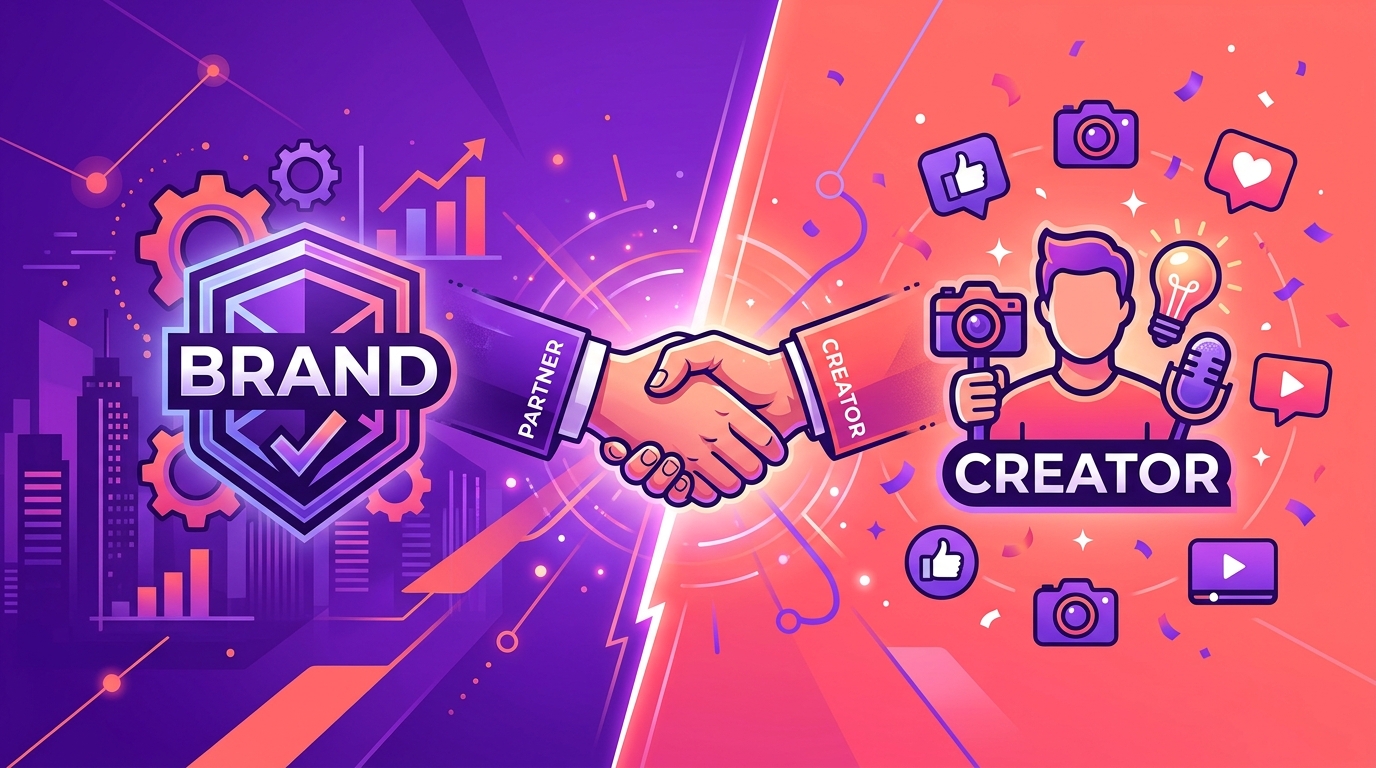
Meta Partnership Ads let your brand run paid advertising directly from a creator's Instagram or Facebook handle. Instead of seeing an ad from your brand account, users see a "Paid partnership with [Brand]" label under the creator's name.
It looks like content. Because it is content — just boosted with your budget and targeting.
This format was previously called Branded Content Ads. Meta rebranded and expanded it as Partnership Ads in recent years, adding the Partnership Ads Hub in Business Manager to centralize creator management, performance tracking, and permissions.
The core mechanics are simple:
→ A creator posts content featuring your product (or you create it together)
→ They grant you permission to run it as an ad
→ You run the promotion through Ads Manager with your full targeting stack
→ The ad appears under the creator's handle with a "Paid partnership" tag
The reason this performs is trust. Audiences treat creator content differently than brand content. The "Paid partnership" label doesn't tank performance — research shows it actually increases it, because the authentic context outweighs the disclosure.
The Performance Case: Why Ecommerce Brands Should Care About This Format
Let's talk numbers, because this is where the conversation usually ends for skeptics.
Meta's internal marketing science research found:
→ 53% higher CTR when partnership ads run alongside standard campaigns (vs. standard-only)
→ 19% lower CPA compared to running brand-only creative
→ 71% higher brand lift in awareness metrics
→ 99% probability of outperforming campaigns that use standard ads alone
→ 82% probability of winning specifically on purchase outcomes
That last one matters most for ecommerce. An 82% probability of better purchase outcomes isn't a margin stat — it's a competitive edge.
Here's what that looks like in dollars: if you're spending $10,000/month on Meta ads and your current CPA is $80, a 19% reduction brings it to $64.80. That's $1,520 back per month — over $18,000 annually — from adding creator content to your existing campaigns. Not replacing what you're doing. Adding to it.
The mechanism isn't magic. Meta's algorithm rewards engagement signals, and creator content generates more of them: longer watch times, more saves, more comments. More engagement = more delivery = lower CPMs and better CPA over time.
Who This Format Works Best For
Not every brand is positioned equally for partnership ads. Here's where this format does the most damage:
Fashion and swimwear brands. Your product looks better on a real person in their element than it does on a white background or even a professional shoot. Creators show the product in a natural context — beach, outfit of the day, "I found this brand" style content. That authentic framing converts.
Health and natural products brands. This category lives and dies by trust. A creator talking about why they use a supplement, a natural skincare product, or a wellness item carries social proof that no brand ad can manufacture. Especially for a category where Meta's ad policies are getting tighter — creator-led content built around genuine experience is both more compliant and more convincing.
Brands already doing influencer outreach. If you're sending product and building relationships with creators, you're leaving money on the table if you're not amplifying that content as paid ads. The infrastructure is already in place.
Brands hitting a ceiling on standard creative scaling. When your best-performing ad set stops scaling past a certain budget, one of the reasons is that your creative pool is too shallow. Adding creator handles introduces new signals to Meta's machine learning and unlocks delivery at higher spend.
Finding the Right Creators for Your Campaign
Follower count is the wrong filter. Start there and you'll overpay for reach and underdeliver on results.
What you're looking for:
→ Engagement rate over audience size. A creator with 25,000 followers and a 6% engagement rate will outperform one with 250,000 followers at 0.8%. The algorithm amplifies content that already has momentum.
→ Comment quality, not just quantity. Scroll the comments. Are people asking where to buy? Tagging friends? Engaging with the person? Or are they just emoji reactions and "🔥🔥🔥" bots?
→ Authentic fit with the product. This sounds obvious, but it gets skipped. Would this person actually use your product? Does their content aesthetically match your brand? A creator who's genuinely into what you sell will outperform a hired gun every time.
→ Content that already looks like what you want to run. If you're selling swimwear, find creators whose existing posts could double as ads for you. That alignment reduces production friction and the ads perform better because they feel native.
Where to find them:
→ Meta Creator Marketplace (inside Business Manager) — filter by niche, country, content format, and follower range. Look for the "Open to partnerships" flag.
→ Instagram search — search hashtags in your category, look at who's creating original content (not just reshares)
→ Your own customer base — customers who post about your products are already warm. Reach out.
Micro vs. macro creators:
For most ecommerce brands in the $500K–$5M revenue range, micro-creators (10K–100K followers) are the sweet spot. Lower cost, higher engagement, more authentic content, easier to build relationships with. Save the macro-influencer budget for awareness plays, not conversion campaigns.
How to Set Up Meta Partnership Ads: Step-by-Step
Step 1: Connect with the Creator
Reach out through Meta Creator Marketplace or direct message on Instagram. Be specific: tell them what you're building, what the ad will look like, and what you're offering (product, payment, or both).
Step 2: Establish Permissions
There are two paths:
- Account-level permissions — the creator approves your brand in the Partnership Ads Hub, giving you ongoing access to run ads from their handle without approving each post individually. Best for long-term partnerships.
- Content-level permissions — the creator enables "Allow brand partner to boost" on a specific post when tagging you with the paid partnership label. Best for one-off collaborations.
For most ecommerce brands starting out, content-level permissions are the easier entry point.
Step 3: Creator Posts the Content
Have the creator post their content (or your approved content) to their feed or stories. They tag your business account using the "Add paid partnership label" feature. You'll get a notification in your Partnership Ads Hub.
Step 4: Build the Ad in Ads Manager
When creating a new ad, select "Use existing post" and choose the creator's post from your approved partnerships list. From here, the setup is identical to any other campaign: objective, audience, budget, placements.
Step 5: Launch and Monitor
Partnership ads require the same learning phase patience as standard ads. Give them 7–14 days before drawing conclusions. The signal looks different from brand ads — you'll often see slower starts followed by steeper performance curves as the algorithm learns.
Partnership Ads Hub location: Business Manager → Brand Safety → Partnership Ads Hub (or search "Partnership Ads" in the Business Manager search bar).
What to Brief Your Creators On
This is where most brands get it wrong. They over-script the content, strip the creator's voice out of it, and then wonder why the "creator ad" performs like a brand ad.
Your brief needs three things and three things only:
- The hook — what's the opening line or first 3 seconds supposed to accomplish? (Example: "I've tried every natural sunscreen, here's the one I actually use.")
- The key product point — one specific benefit, claim, or proof point you want mentioned. Not five. One.
- The CTA — where do they send people? What action should viewers take?
Then stop. Let the creator write the script, choose the format, and deliver it in their voice. That's what you're paying for.
The most common brief mistake: sending a 4-page document with approved language, competitor disclaimers, and "please mention X, Y, and Z." Creators know their audience. Trust them to translate your brand message into their format.
Format guidance:
→ Reels outperform static for this format — Meta prioritizes short-form video across both Instagram and Facebook
→ Vertical video (9:16) is non-negotiable
→ Hook in the first 3 seconds — this is where view rate is won or lost
→ Keep it under 60 seconds for conversion campaigns
Campaign Structure That Actually Works
Don't replace your standard campaigns with partnership ads. Add them.
The highest-performing structure for ecommerce brands running partnership ads:
Campaign level: Sales objective (or Traffic if testing top-of-funnel)
Ad set 1 — Brand Creative: Your standard brand assets, best-performing from the last 30 days
Ad set 2 — Creator/Partnership: 3–5 creator posts approved as partnership ads
Run both ad sets with similar budgets. Let Meta's delivery system allocate based on performance signals. You'll see within 10–14 days which format is winning for which audience.
Once a creator-led creative is outperforming, scale it: increase budget by 20% every 3–4 days. Don't jump — let the algorithm recalibrate. If you don't have a systematic approach to creative testing already, read our Meta Ads creative testing framework before scaling.
On Advantage+ Shopping Campaigns: If you're running ASC, partnership ads can be added directly as creative assets within the campaign. Meta's AI will route budget to the highest-performing assets including creator content. This is the most frictionless integration point if you're already on ASC. (See our complete Advantage+ Shopping setup guide for how to structure your ASC campaigns before layering in creator content.)
Budget tip: Budget at least 3–5x what you'd spend on a standard creative production for the partnership content creation fee. The amplification cost (ad spend) is the same as normal — but under-investing in the creative relationship kills results before the campaign starts.
Metrics to Track
Primary (what actually matters):
→ CPA (cost per acquisition / cost per purchase)
→ ROAS (return on ad spend)
Secondary (diagnostic):
→ CTR (link click-through rate) — leading indicator of creative resonance
→ CPM — rising CPM means you're in competitive auctions (normal) or the algorithm is struggling to find the right audience (not good)
→ Hook rate (3-second video view rate ÷ impressions) — if this is below 20%, your opening isn't working
Qualitative signals:
→ Comment sentiment — read the comments. "Where can I buy this?" is a conversion signal your dashboard won't show you. Negative comments about the brand or creator fit are early warning signs.
→ Shares — high share rate on a partnership ad means the content is working as organic content, not just as an ad. That's the ideal outcome.
Don't optimize on CTR alone. High CTR with low conversion rate means your landing page is the bottleneck, not the creative. Before you swap out the creator, check your LP conversion rate. Not sure what a healthy ROAS benchmark looks like for your category? Here's our 2026 breakdown by niche.
Common Mistakes Ecommerce Brands Make with Partnership Ads
Picking creators based on followers, not fit. Already covered — but worth repeating. A macro-influencer with 500K followers and 0.5% engagement in your niche will cost you 10x more and convert at a fraction of the rate.
Over-scripting the content. You hired the creator for their voice. If your brief strips it out, you've paid for a lower-quality brand ad with a stranger's face on it.
Testing with too-small a budget. Partnership ads need time to exit the learning phase just like any other campaign. Running $500 for 5 days and calling it a failed test is a waste of everyone's time. Commit to a real test: $2,500–$5,000 minimum over 14 days.
Treating creators as vendors instead of collaborators. The brands building the strongest creator programs treat creators like teammates — they share performance data, give feedback, renew relationships that work, and build compounding content libraries over time. That's how you go from one partnership ad to a creator content machine.
Ignoring the comment section. This is free market research. The comments on high-performing partnership ads will tell you exactly why people are buying (or not) — objections, enthusiasm, confusion, questions. Mine it.
The Bottom Line
Partnership Ads aren't a magic format. They're leverage.
The brands winning on Meta right now have figured out that the algorithm rewards authentic engagement signals — and creator content generates more of them than brand creative, almost by default. The 53% CTR lift and 19% CPA reduction aren't promises. They're what happens when you run ads that don't look like ads.
Most ecommerce brands in the $500K–$5M range are sitting on untapped potential here: relationships with creators, a customer base that loves the product, and ad accounts that need fresh signal. Partnership Ads are the bridge.
The playbook is straightforward: find creators who genuinely fit the product, give them a tight brief with room to work, build partnership ads alongside your standard campaigns, and measure what actually matters — CPA and ROAS, not likes.
If you want to see how this fits your brand's specific situation — what creator profile makes sense, how to structure the test, what budget to start with — book a strategy session. No pitch, no fluff. Just a clear plan.
Book a free strategy session →
Dash Activate Online is a Meta Ads agency for ecommerce brands in fashion, swimwear, and health/natural products. We help brands scale paid social with creative systems that compound over time.