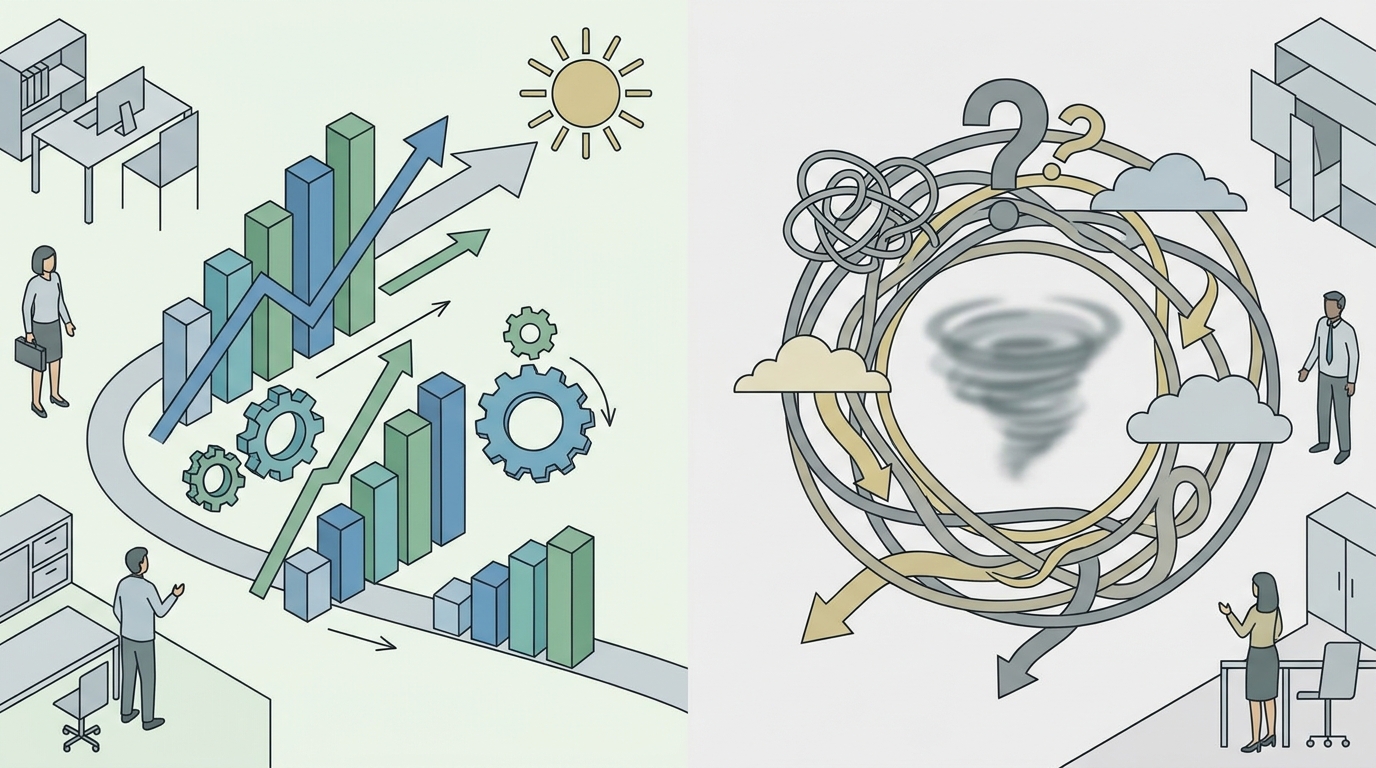
Most ecommerce founders get the timing wrong when deciding when to hire a Meta ads agency. They either wait too long — watching ROAS erode and CAC climb while they try to diagnose a problem they don't have the data to solve — or they hire too early, before they have the offer, creative infrastructure, or ad spend to actually benefit from an agency.
Hiring too early means you're paying agency fees to run ads against an unvalidated offer. Hiring too late means you've spent months leaving money on the table. Either way, the timing matters as much as who you hire.
This guide gives you seven concrete signs that your ecommerce brand is at the inflection point where hiring a Meta ads agency will actually pay off — and four honest signals that you're not there yet.
Key Takeaways
- The right time to hire a Meta ads agency is when internal constraints — not the offer, product, or market — are the binding constraint on growth.
- Most ecommerce brands in the $500K–$5M revenue range are ready to work with an agency once they're spending $10K+/month on Meta and have a proven product.
- Agencies don't fix broken offers. They accelerate what's already working.
- The 7 signs below are operational signals, not just revenue milestones — most founders need 3 or more to justify the hire.
- Signs you're NOT ready: unvalidated offer, under $5K/month ad spend, sub-30% contribution margins.
What Does "Ready" Actually Mean for a Meta Ads Agency Partnership?
Being ready to hire a Meta ads agency isn't just a revenue number. It's a combination of three things: spend volume (enough data for the algorithm to learn), creative infrastructure (assets an agency can actually test), and business fundamentals (margins that survive agency fees and profitable scaling).
Brands that nail all three typically see positive ROAS within 60–90 days of onboarding. Brands missing one typically spend the first 2–3 months building infrastructure before any real scaling starts. That's not the agency's fault — it's a readiness problem that should've been caught before the engagement started.
The 7 signs below cut through the vague "when you feel ready" advice. These are the operational moments that actually signal the timing is right.
Sign #1: Your ROAS Has Plateaued and You Can't Diagnose Why
Your ads were working. Then they stopped improving — or got worse. You've tried new audiences, different budgets, refreshed creatives. The ROAS sits at the same number (or lower) month after month, and you don't have a clean read on what's actually causing it.
This is one of the clearest signs you need outside expertise. ROAS plateaus have specific causes: creative fatigue at the ad set level, audience saturation, attribution drift, Advantage+ budget misallocation, or a combination. Diagnosing it correctly requires knowing what to look for — and most founders don't have the reference base to distinguish them.
An experienced Meta ads agency will have seen these patterns across dozens of accounts. They know what a creative fatigue drop looks like vs. an attribution issue vs. a CPM spike driven by seasonal competition. They can diagnose in days what takes a generalist weeks — or what a busy founder never gets around to diagnosing at all.
The question isn't whether your ads could be better. It's whether you have the expertise to figure out why they're not.
Sign #2: You're Spending $10K+/Month and Still Managing It Manually
There's a spend threshold beyond which the opportunity cost of managing Meta ads yourself starts to compound. For most ecommerce founders, that's $10,000–$15,000/month in ad spend.
Below that, you can stay close to the account and move quickly. Above it, the complexity increases nonlinearly: more campaigns, more creative rotations, more audience segments, more Advantage+ signals to monitor. You're spending hours inside Ads Manager that could be spent on product, operations, or customer relationships.
The math is blunt: at $15K/month in spend, even a 15% ROAS improvement from better management is worth $2,250/month. A good Meta ads agency's fee is typically $2,000–$5,000/month at that level. The math only gets better as spend scales.
If you're managing five figures in Meta spend and still doing it yourself, you're not saving money — you're trading your highest-leverage hours for a task that someone else can do better.
Sign #3: Creative Production Can't Keep Up With Ad Fatigue
Meta's algorithm, particularly after the Andromeda update, rewards creative volume. Frequency kills performance. The accounts that scale profitably are running new creative concepts weekly — not monthly.
If you're launching two or three new concepts per month, you're already behind. Ad fatigue hits faster than most founders expect: on a compressed audience of 200K–500K cold prospects, a single creative can start losing efficiency within two to three weeks.
An agency that specializes in ecommerce Meta ads builds this into the workflow. Creative briefs, production partners, asset organization, and rotation schedules are systematized — not a scramble every time a ROAS drops.
For fashion and swimwear brands especially: creative differentiation IS the targeting. A swimwear brand running five similar lifestyle shots is essentially testing nothing. The agency's job is to build the creative testing system that actually produces signal.
If you're constantly reacting to creative fatigue instead of staying ahead of it, you don't just need more creatives — you need a creative testing system. That's an agency-level capability.
Sign #4: Your CAC Is Climbing Without a Clear Fix
Customer acquisition cost should be stable or declining as you find your winning audiences, angles, and creative formats. If CAC has been climbing for more than two to three months and you don't have a clear diagnosis, that's a problem a Meta ads agency is equipped to solve.
Rising CAC on Meta has a short list of real causes: creative fatigue, audience exhaustion, landing page degradation, iOS attribution gaps, or competitive CPM pressure. Each has a different fix. Guessing at the cause and adjusting settings randomly doesn't work — it just creates noise.
Agencies track CAC trends across clients in the same vertical. They have a pattern base. When a fashion brand's CAC starts climbing in Q3, an experienced agency knows whether it's a cyclical CPM issue or a structural creative problem — because they've seen it across multiple accounts at the same time of year.
CAC drift is one of the most valuable things an agency can diagnose early. Catching it 30 days earlier than you would solo is often worth more than the full year of agency fees.
Sign #5: You've Hit a Revenue Ceiling You Can't See Around From Inside
Some growth ceilings are visible from inside the business. Others aren't — because you're too close to see which variable is actually binding.
The classic case: revenue has plateaued at $800K or $1.2M, the team is working harder, and nothing obvious is broken. The instinct is to blame ads. But the real constraint might be offer positioning, landing page conversion, email flow, or creative that's been running for too long.
An external team with account-level visibility and a performance-based relationship has every incentive to find the real bottleneck — not just optimize what's already there. They'll look at the full funnel, not just the Ads Manager dashboard.
This is also where an agency adds strategic value beyond campaign management: fresh eyes on what's actually constraining growth vs. what just looks like the problem from the inside.
Sign #6: Q4 or a Major Sales Season Is 60–90 Days Away
If your brand has seasonality — and for fashion, swimwear, and health brands it almost always does — Q4 and peak season prep starts 60–90 days out. That's when agency capacity gets locked up, when creative lead times matter, and when campaigns need to be built and tested before the season hits.
Brands that wait until October to think about holiday Meta campaigns are already behind. The algorithm needs time to learn. Pixel data needs to be clean. Creative needs to have been tested. Retargeting audiences need to be built.
If Q4 or your peak season is 60–90 days away and you don't have a clear paid media plan in place, that's your signal to hire now — not after the season starts.
An agency onboarding in August for Q4 has time to audit the account, build campaigns, launch creative tests, and let the algorithm warm up before Black Friday. An agency hired in late October is firefighting from day one.
Sign #7: You Just Lost Your In-House Meta Ads Person — or Never Had One
Founder-run Meta accounts hit a ceiling. So do accounts managed by a generalist marketing hire who runs ads alongside five other responsibilities. When that person leaves — or when you realize you never actually had dedicated expertise — the gap is real and the timeline to fill it is long.
Hiring a full-time in-house Meta ads specialist takes 60–90 days minimum (recruiting, onboarding, ramp-up). An agency can be operational within 2–3 weeks.
More importantly: a good agency brings a team, not a person. Account managers, creative strategists, performance analysts — the expertise is distributed. One in-house hire brings one skill set. An agency brings a system.
Signs You're NOT Ready to Hire a Meta Ads Agency
Be honest. If any of these are true, hiring an agency won't fix the problem.
| Signal | What It Means |
|---|---|
| You haven't validated your offer | Ads will drive traffic to something that doesn't convert. Agencies can't fix a broken offer. |
| Monthly ad spend is under $5K | Below this threshold, there's not enough data for the algorithm to optimize. You'll spend the budget learning, not scaling. |
| Contribution margins are under 30% | After COGS, shipping, and Meta ad spend, you need room for an agency fee and still produce profit. Thin margins don't survive agency economics. |
| You have no creative assets | An agency can help brief and strategize creative — but they need something to work with. Launching with stock imagery and screenshots isn't a testing strategy. |
| The website converts below 1% | Meta ads can't fix a landing page problem. Fix CVR first, then scale paid traffic. |
Here's the hard truth: the most common scenario where founders burn money on agencies is hiring before the offer is validated. Ads amplify what's there. If what's there doesn't convert, you'll just find out faster — and more expensively.
What to Look For Once You've Decided to Hire
Once you've confirmed the timing is right, evaluate agencies on specificity, not promises.
- Vertical experience: Have they managed accounts in your category? Fashion and health ecommerce have different creative constraints, policy environments, and audience dynamics. Generic "ecommerce experience" isn't the same as category-specific expertise.
- Creative testing process: Ask how they structure creative tests, how often they introduce new concepts, and how they decide when to cut vs. scale. Vague answers here are a red flag.
- Reporting and attribution: Do they track the metrics that matter for your model (CAC, contribution margin, LTV/CAC ratio) — or just ROAS and spend?
- Minimum spend requirements: Most reputable agencies require $5K–$15K/month in ad spend. Agencies working with very low budgets often can't generate meaningful data fast enough to produce results.
For a detailed cost comparison between agency and in-house options at different spend levels, see our full breakdown: Meta Ads Agency vs. In-House: The Real Cost for Ecommerce Brands.
Frequently Asked Questions
What revenue level do I need before hiring a Meta ads agency?
Most agencies work best with brands doing $500K–$5M in annual revenue, with at least $5,000–$10,000/month in monthly ad spend. Below that threshold, the data volume is often too low for meaningful optimization, and agency fees consume too large a share of ad spend. That said, revenue is a proxy — what actually matters is spend, margins, and offer validation.
How much does a Meta ads agency cost for ecommerce?
Typical fees range from $2,000–$6,000/month for brands spending $10K–$50K/month in ad spend. Some agencies charge a percentage of ad spend (typically 10–20%), others charge flat retainers. At higher spend levels ($50K+/month), percentage models can become expensive quickly — negotiating a blended or capped fee matters.
How long does it take to see results after hiring a Meta ads agency?
Most brands in the fashion and health ecommerce space should expect 60–90 days to see stabilized, optimized performance. The first 30 days are typically audit + account restructure + creative launch. Days 31–60 are testing and optimization. Day 60+ is where compounding from well-structured campaigns starts to show.
What's the difference between a Meta ads agency and a freelancer?
An agency brings a team with distributed expertise (strategy, creative, media buying, reporting). A freelancer is one person with one skill set. Agencies cost more but provide more coverage, redundancy, and institutional knowledge. For brands spending $15K+/month, the team depth of an agency is usually worth it.
When is the wrong time to hire a Meta ads agency?
When your offer isn't validated, when you're spending under $5K/month, or when your conversion rate is below 1%. Also: if you're hoping the agency will fix a problem that actually lives in your product, pricing, or landing page — that's not what paid media solves.
The Bottom Line
The right time to hire a Meta ads agency isn't when things are falling apart. It's when internal constraints — bandwidth, expertise, creative capacity, diagnostic depth — are the ceiling on your growth, not your product or offer.
If 3 or more of the 7 signs above describe where your brand is right now, the timing is right. Waiting another quarter won't change the diagnosis — it'll just cost you the quarter.
If you want to see where your Meta account actually stands before making a decision, book a strategy call. We'll show you what we see, tell you where the real gaps are, and give you an honest read on whether an agency is the right move for where you are.
No pitch, no pressure. Just clarity.
Schema Markup (include on publish):
{
  "@context": "https://schema.org",
  "@graph": [
    {
      "@type": "Article",
      "headline": "When to Hire a Meta Ads Agency for Your Ecommerce Brand: 7 Signs You're Ready",
      "author": {
        "@type": "Person",
        "name": "Darian James"
      },
      "publisher": {
        "@type": "Organization",
        "name": "Dash Activate Online",
        "url": "https://dashactivateonline.net"
      },
      "datePublished": "2026-08-11",
      "description": "7 concrete signs your ecommerce brand is ready to hire a Meta ads agency — and 5 signs you're not. Written by an ecommerce Meta ads agency for fashion and health brands."
    },
    {
      "@type": "FAQPage",
      "mainEntity": [
        {
          "@type": "Question",
          "name": "What revenue level do I need before hiring a Meta ads agency?",
          "acceptedAnswer": {
            "@type": "Answer",
            "text": "Most agencies work best with brands doing $500K–$5M in annual revenue, with at least $5,000–$10,000/month in monthly ad spend. What actually matters is spend, margins, and offer validation — not revenue alone."
          }
        },
        {
          "@type": "Question",
          "name": "How much does a Meta ads agency cost for ecommerce?",
          "acceptedAnswer": {
            "@type": "Answer",
            "text": "Typical fees range from $2,000–$6,000/month for brands spending $10K–$50K/month in ad spend. Some agencies charge a percentage of ad spend (10–20%), others charge flat retainers."
          }
        },
        {
          "@type": "Question",
          "name": "How long does it take to see results after hiring a Meta ads agency?",
          "acceptedAnswer": {
            "@type": "Answer",
            "text": "Most ecommerce brands in fashion and health should expect 60–90 days to see stabilized, optimized performance. The first 30 days are audit and account restructure; days 31–60 are testing and optimization; day 60+ is where compounding starts."
          }
        },
        {
          "@type": "Question",
          "name": "When is the wrong time to hire a Meta ads agency?",
          "acceptedAnswer": {
            "@type": "Answer",
            "text": "When your offer isn't validated, when you're spending under $5K/month, or when your conversion rate is below 1%. Also when you're hoping the agency will fix a problem that lives in your product, pricing, or landing page."
          }
        }
      ]
    }
  ]
}