If your Meta ads are bleeding budget and your creative fatigue is real, there’s a lever most ecommerce brands haven’t pulled yet: Meta Partnership Ads.
Not influencer whitelisting (the old way). Not boosted posts. Partnership Ads — Meta’s evolved framework for running paid ads directly from a creator’s handle, with full campaign control on your end. The result? Ads that look like organic creator content, with the targeting precision of a performance campaign.
The data backs it up: brands running Partnership Ads are seeing 53% higher click-through rates and 19% lower CPAs compared to standard brand-page ads. For fashion, swimwear, and health/wellness DTC brands dealing with rising acquisition costs, this isn’t a nice-to-have — it’s a competitive edge.
Here’s exactly how it works and how to run it.
What Are Meta Partnership Ads?
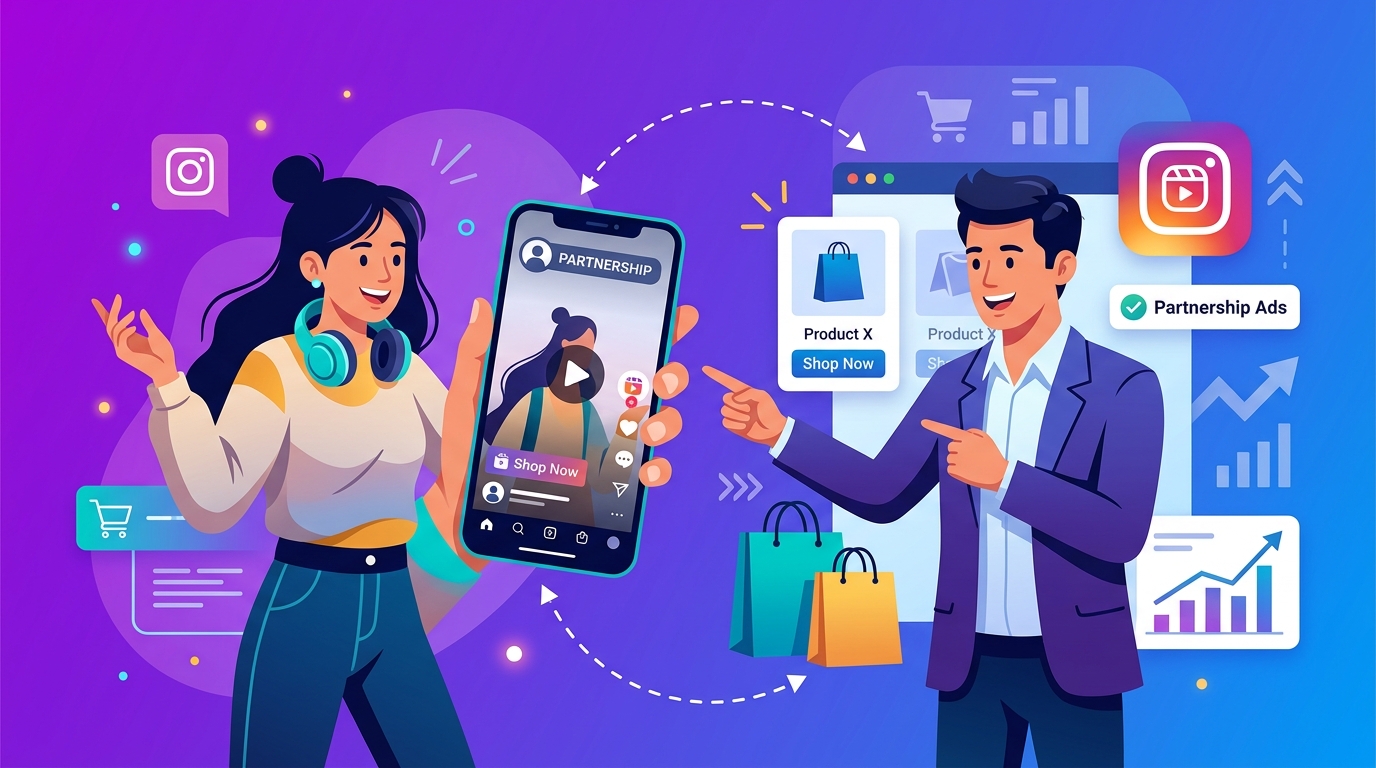
Meta Partnership Ads (formerly called Branded Content Ads) are a paid ad format that lets brands run ads from a creator’s Instagram or Facebook handle — not from the brand’s own account.
The ad shows up in a user’s feed, Stories, or Reels with the creator’s profile picture and name front and center. There’s a small “Paid partnership with [Brand]” label underneath. That’s it. To a cold audience scrolling at 11pm, it looks like content from someone they follow — not an ad from a brand trying to sell them something.
How it’s different from a standard boosted post:
- Boosted post: Creator posts, brand pays to amplify it. Limited targeting. Shows from creator’s handle but brand has minimal control over audience, budget, or optimization.
- Partnership Ad: Brand builds the full campaign in Meta Ads Manager using the creator’s handle as the “identity.” Full control over audience, bid strategy, placements, and creative — the creator just grants permission.
That distinction matters enormously. You get the social proof of creator content with the performance infrastructure of a direct-response campaign.
Why Partnership Ads Are Outperforming Standard Creative Right Now
Three forces are converging in 2026 that make Partnership Ads unusually effective:
1. Ad fatigue is destroying brand-page creative
After years of DTC brands running the same polished product shots and UGC testimonials from their own accounts, Meta audiences have developed sophisticated ad blindness. The moment someone sees a brand handle in the corner, their guard goes up. CAC benchmarks reflect this — fashion brands are averaging $66–$150 per acquisition, health/wellness hitting $70–$300+. Margins are getting squeezed.
Partnership Ads sidestep the brand-page trigger entirely. The creative originates from a trusted creator identity.
2. Reels dominance is benefiting creator-format content
Reels now account for more than 50% of time spent on Instagram. Meta’s algorithm heavily rewards Reels engagement. Creator-style Reels content — raw, direct-to-camera, showing a real person using your product — performs dramatically better than brand-produced video in this format. In 2026, Reels-format Partnership Ads are outperforming feed and Stories variants in most ecommerce verticals.
3. Meta’s Andromeda update rewards authenticity signals
Meta’s Andromeda ranking system update placed significant weight on engagement authenticity — real comments, saves, shares from accounts with social graphs attached to the content. Creator content naturally generates stronger authenticity signals than brand-page content, which feeds back into lower delivery costs and better reach.
This is why the 53% CTR lift isn’t just about “looking organic” — it’s the algorithm actively preferring creator-handle content at the delivery level.
How to Set Up Meta Partnership Ads Step-by-Step
The setup involves three stages: creator permission, ad creation, and campaign launch. Here’s the full flow:
Step 1: Creator grants advertising permissions
The creator needs to enable ad permissions in their Instagram/Facebook settings:
- Creator goes to their Instagram profile → Settings → Creator → Branded Content
- Turns on “Allow Business Partner Tag”
- You (the brand) search for the creator in Meta Business Manager → Partnerships → Creator Ads
- Send an ad permission request to the creator’s account
- Creator approves the request
Once approved, the creator’s handle becomes available as an identity option in your Ads Manager.
Step 2: Create the campaign in Meta Ads Manager
- Open Ads Manager → Create Campaign → choose your objective (Sales, Traffic, or Lead Gen depending on your funnel)
- At the ad set level, define your audience: start with creator’s followers + lookalikes of their post engagers
- At the ad level → Identity → select “Creator Ad” → choose the approved creator’s handle
- Upload your creative (Reels video, image, or carousel) or pull from the creator’s existing organic content
- Add your primary text, headline, CTA button, and destination URL
Step 3: Launch and monitor
Run the Partnership Ad alongside your standard brand-page creative as an A/B test. Give each variant at least $50/day and 7–10 days of data before drawing conclusions. Most brands see Partnership Ads pull ahead within the first week on CTR; CPA lift usually becomes clear by day 10–14.
For more on creative testing methodology, see our Meta Ads creative testing framework for ecommerce.
How to Choose the Right Creator Partner for Your Ecommerce Brand
The biggest variable in Partnership Ads performance is the creator. A misaligned creator will drag down even a well-structured campaign. Here’s what to look for:
Audience alignment over follower count
A creator with 15,000 followers whose audience is 80% women aged 25–40 interested in activewear will outperform a creator with 200,000 followers whose audience is broad and diluted. Request audience demographic screenshots or use Meta’s Creator Marketplace to verify before committing.
Engagement rate benchmarks by vertical
- Fashion/Swimwear: Look for 3–6% engagement rate on Reels, 1.5–3% on feed posts
- Health/Natural Products: Look for 4–8% on Reels (niche audiences engage harder), 2–4% on feed
- Anything below 1% engagement is a red flag regardless of vertical
Content style fit
Watch their last 10–15 posts. Does their natural content style fit how your product would be used? A creator who posts polished flat-lays won’t be effective for a health supplement brand that needs authentic “here’s how I use this” content. Match the content style to your product’s value proposition.
Track record with brand partnerships
Creators who have done brand deals before understand the ad permission workflow and generally deliver better compliance. Ask if they’ve run Partnership Ads before — it saves setup headaches.
Creative Best Practices for Partnership Ads That Convert
The creative is where most brands leave performance on the table. Here’s what’s working in 2026:
Lead with the creator, not the product
The first 2 seconds of a Reels Partnership Ad should show the creator’s face or voice — not a product shot. The audience follows this creator. Start with them, and let the product enter naturally in the first 5 seconds.
Native format beats polished production
Shot on iPhone, slightly imperfect framing, natural lighting — this style outperforms studio-produced video in Partnership Ads because it matches the creator’s organic content and doesn’t break the feed experience. If you’re sending a creator a professional video brief asking for pristine output, you’re undermining the format’s advantage.
Specific hooks over generic claims
“I’ve been wearing this swimsuit every day for two weeks and here’s what happened to my confidence” converts better than “Check out this cute swimsuit.” Specificity and personal narrative are the currency of Partnership Ad creative. Brief creators on the core transformation your product delivers, then let them tell it in their voice.
Format hierarchy for 2026
- Reels (9:16 vertical video): Highest reach and lowest CPMs, performing best across fashion and health verticals
- Feed (1:1 image or carousel): Strong for product-focused content with clear visual differentiation
- Stories (9:16): High-intent retargeting; less effective for cold audiences in Partnership format
Real Results: What Ecommerce Brands Are Seeing in 2026
The headline numbers are compelling — 53% higher CTR and 19% lower CPA across Meta’s own benchmarks — but here’s what those numbers look like in practice for DTC brands:
Fashion/Swimwear
Brands in this category running Partnership Ads with micro-influencers (10K–100K followers) are seeing link CTR in the 2.5–4% range (vs. 0.8–1.5% for standard brand creative) and CPAs 15–25% below their brand-page campaigns. The format particularly excels for new customer acquisition against cold audiences who don’t know the brand yet.
Health/Natural Products
For supplement and wellness brands navigating Meta’s health product advertising restrictions, Partnership Ads offer an additional compliance buffer — creator content typically triggers fewer policy flags than brand-page ads making direct health claims. Brands are reporting 30–40% lower CPAs when running through creator handles versus brand pages for health supplement products.
DTC Brands Broadly
The pattern across verticals: Partnership Ads perform best as a cold-audience acquisition tool, paired with standard brand creative for retargeting. Brands blending both see overall blended CAC reductions of 15–20% within 60 days of launching a consistent creator partnership program.
Common Mistakes Brands Make with Partnership Ads
Most brands that try Partnership Ads and declare them “didn’t work” are making one of these errors:
Mistake 1: Over-scripting the creator
Handing a creator a word-for-word script kills the authenticity that makes the format work. Brief them on the outcome you want, the key proof points, and the CTA. Let them execute in their own voice.
Mistake 2: Running from the wrong audience
Don’t just run broad targeting because it’s a creator ad. Start with the creator’s own followers + a 1–2% lookalike of people who have engaged with the creator’s posts in the last 90 days. This audience already has a relationship with the creator and converts significantly better.
Mistake 3: Testing one creator then quitting
Creator performance varies enormously. One creator’s audience might be heavily international or skew older than their follower count suggests. Build a stable of 3–5 creators, test all of them with modest budgets ($30–$50/day each), identify the top performer, then scale that one aggressively.
Mistake 4: Letting the permission lapse
Creator ad permissions expire or can be revoked. If a campaign suddenly stops delivering or shows an error, check the permission status first. Build a simple monthly check into your account hygiene process.
Mistake 5: Not running it as an always-on program
Partnership Ads aren’t a one-off campaign tactic. The brands extracting the most value run it as an ongoing acquisition channel — rotating creators quarterly, testing new creative angles monthly, and continuously optimizing the creator mix based on CAC data.
Is Meta Partnership Ads Right for Your Brand?
Partnership Ads are a strong fit if:
- You’re spending $5K+/month on Meta ads and hitting creative fatigue
- Your product is visual and lifestyle-driven (fashion, swimwear, health/wellness, beauty)
- You have or can build relationships with creators in your niche who have engaged, aligned audiences
- Your current brand-page creative CTR is below 1.5% on Reels
- You’re in a category where social proof and peer recommendation drives purchase decisions
They’re less ideal if:
- You’re in a purely B2B or technical product category where creator affinity doesn’t translate to purchase intent
- You’re below $3K/month ad spend (better to nail your core creative first)
- You can’t find creators with audiences that genuinely overlap with your buyers
For most ecommerce brands in fashion, swimwear, and health/wellness, Partnership Ads should be in your active campaign mix right now. The brands winning in 2026 aren’t choosing between performance marketing and creator content — they’re combining them.
Ready to run Partnership Ads the right way? If you want a strategic review of your current Meta ad setup and a roadmap for integrating creator partnerships into your acquisition mix, book a free strategy call with our team. We work specifically with fashion, swimwear, and health/wellness DTC brands doing $500K–$5M in revenue.