Meta In-Ad Checkout for Ecommerce: What the New Buy Now Button Means for Your Sales
The single biggest killer of ecommerce conversions isn't your landing page. It isn't your offer. It isn't even your creative.
It's the gap between "I want this" and "I bought this."
Every redirect, every loading screen, every new form field is a chance for a customer to change their mind, get distracted, or close the tab. That gap — the friction between discovery and purchase — has always been Meta's biggest weakness as a sales channel.
Meta just moved to close it.
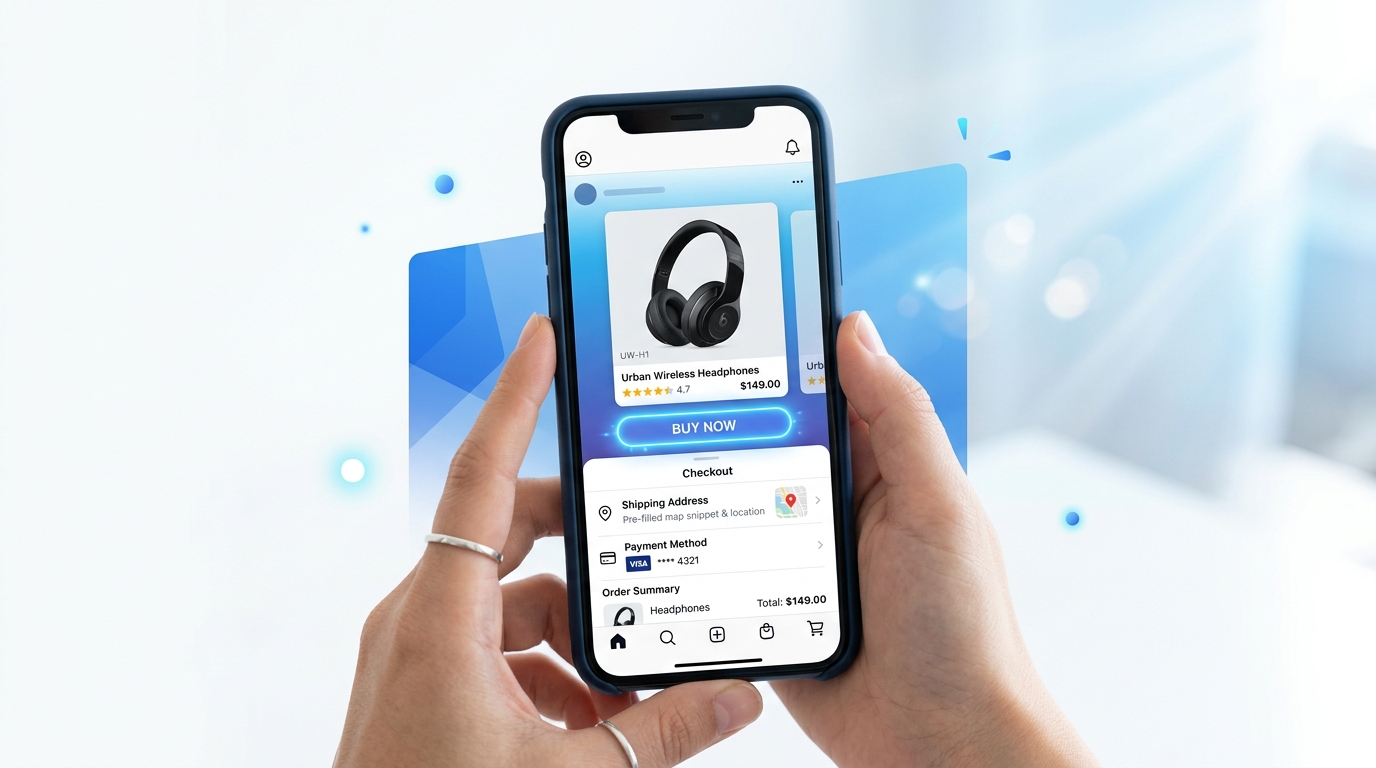
In early 2026, Meta partnered with Stripe to roll out meta in-ad checkout for ecommerce: a native Buy Now button embedded directly inside Facebook ads. Customers see your ad, tap Buy Now, and complete the entire purchase without ever leaving Facebook. Powered by saved credentials in their Meta wallet and Stripe's Agentic Commerce Protocol, the checkout takes a matter of seconds.
This is not a minor feature update. For ecommerce brands in fashion, swimwear, and health — categories where impulse and visual appeal drive purchases — this could fundamentally shift how you think about your funnel.
Here's what you need to know.
What Is Meta In-Ad Checkout?
Meta in-ad checkout is a native purchasing experience that lets buyers complete transactions directly within the Facebook app after clicking a Buy Now button on an ad — no redirect to your website required.
The experience works like this:
- A customer sees your ad in their Facebook feed
- They tap the Buy Now button
- Meta surfaces a native checkout interface — no app switching, no new browser tab
- Their saved payment info from their Meta wallet pre-fills automatically
- They confirm and the purchase is done
Stripe powers the payment infrastructure through its Agentic Commerce Protocol (ACP), a new framework designed for seamless, AI-era purchasing flows. PayPal is also a launch partner for related checkout flows through Meta's Business AI.
Launch partners include Fanatics (sports merchandise) and Quince (quality-at-cost apparel) — both high-volume ecommerce operators with exactly the right customer profile for this kind of frictionless buying.
Currently, the feature is live on Facebook, with Instagram integration coming next.
How It Actually Works (The Flow Your Customer Experiences)
Understanding the customer journey here is important, because it's genuinely different from anything Meta has offered before.
Step 1 — Ad Discovery
Your ad appears normally in feed, stories, or reels. The creative, copy, and offer work exactly as they always have.
Step 2 — Buy Now Tap
Instead of a standard "Shop Now" button that redirects to your website, the ad surfaces a Buy Now CTA. This is the new element.
Step 3 — Native Checkout
A Stripe-powered checkout sheet slides up directly within Facebook. The buyer doesn't leave the app. Their saved Meta wallet credentials (payment method, shipping address) are pre-loaded.
Step 4 — One-Tap Confirm
The buyer confirms the order. Transaction complete. Meta sends the order to your fulfillment system. The customer stays in their Facebook feed.
The entire purchase flow — from ad click to confirmed order — happens without your website ever loading. For mobile buyers on 5G or spotty connections, that's a massive advantage.
The Ecommerce Opportunity: Why This Is Bigger Than It Looks
Checkout friction is costing ecommerce brands billions every year. The average mobile cart abandonment rate hovers around 85%. The leading causes: too many steps, slow loading pages, and required account creation.
Meta in-ad checkout eliminates all three for a significant portion of your audience — specifically, anyone with a Meta account and saved payment credentials. That's a lot of people.
Here's why the opportunity is particularly high right now:
Almost no one is talking about it yet. The feature launched in March/April 2026 and most agency blogs and ecommerce publications haven't covered it with any depth. Early adopters are going to test this with essentially zero competitive noise.
The data on in-app checkout is compelling. Meta's own research shows advertisers using both website and Meta Shop as conversion locations see 30% better incremental ROAS compared to website-only campaigns. Adding an ultra-low-friction checkout option to that mix pushes the numbers further.
Impulse-buy categories are tailor-made for this. Fashion, swimwear, accessories, and health supplements are all products where the decision to buy happens fast. The longer the gap between "I want this" and "I can buy this," the more likely that impulse dies. Native checkout kills that gap.
Mobile is where your customers live. Over 90% of Meta's ad inventory is consumed on mobile. Redirecting mobile shoppers to a website — even a fast-loading, well-optimized one — introduces friction. In-app checkout removes that friction entirely for the mobile experience.
Who Should Enable This First
Not every ecommerce brand should rush to turn this on immediately. Here's how to think about fit:
Strong fit:
- Products under $150 (low-consideration, impulse-buy range)
- Fashion, swimwear, accessories, basic health consumables
- Brands already selling well on Meta with strong creative
- Brands on Stripe (easiest integration path)
- DTC brands with clean, consistent product catalog
Weaker fit (proceed with caution):
- High-ticket or high-consideration purchases ($300+) where customers research extensively before buying
- Brands with complex sizing, customization, or subscription upsell flows built into their website checkout
- Brands where post-purchase email capture and owned data are critical to LTV strategy
- Brands with significant order-level customization that can't be handled natively
The core question is: does your best customer know what they want before they click? If yes, in-ad checkout can convert that intent immediately. If they need to browse, compare, or configure — your website is still the right destination.
How to Set It Up
The good news: if you're already on Stripe, setup is straightforward.
Step 1 — Enable in your Stripe Dashboard
Log into your Stripe Dashboard and navigate to the relevant payments or channels section. There's a toggle to opt into selling via ads on Facebook. Enable it.
Step 2 — Link Your Meta Ads Account
Connect your Meta Business Manager / Ads account within the Stripe integration. This links your product catalog and enables the Buy Now CTA on eligible ads.
Step 3 — Confirm Your Product Catalog Is Clean
In-ad checkout works best with clean, accurate product data — correct pricing, inventory levels, and product descriptions. Any discrepancy between what shows in the ad and what appears in checkout creates friction and potential drop-off.
Step 4 — Create or Adapt Ads with the Buy Now CTA
Not all ad formats will automatically surface the Buy Now button. Work with your media buyer to identify which campaigns and ad sets are best suited to test this format first. Start with your top-performing prospecting or retargeting ads.
Step 5 — Set Up Conversion Tracking
This is critical: make sure your Conversions API (CAPI) is configured to capture in-app purchase events, not just website events. In-ad checkout purchases won't fire your standard pixel events, so attribution needs to be set up correctly from day one.
What to Watch Out For
This feature is powerful, but it comes with trade-offs your team needs to understand.
Data ownership. When a customer buys through Meta's native checkout, Meta owns the primary customer relationship data. You'll get order information, but the depth of behavioral and browsing data you'd capture on your own site is reduced. For brands building rich customer profiles for email sequences and LTV modeling, this matters.
Attribution complexity. Adding a new purchase surface means adding a new attribution variable. Your MER (Marketing Efficiency Ratio) should still capture in-ad purchases, but make sure your reporting is set up to include these conversions. Don't let in-app sales disappear into an attribution black hole.
AOV implications. In-ad checkout is optimized for single-item, fast purchase flows. If your highest-margin orders come from customers who discover upsells, bundles, or subscription options on your website, those conversion paths get bypassed. Monitor average order value carefully when testing this feature.
Refunds and customer service. Think through your post-purchase flow. Customers who buy through in-app checkout may expect Meta-facilitated support rather than your standard customer service channels. Set expectations clearly in order confirmation messaging.
What This Changes About Your Meta Ads Strategy
If Meta in-ad checkout performs the way the data suggests it will, it shifts a few strategic assumptions that most ecommerce brands operate under.
Your landing page is no longer always the conversion point. The best ecommerce brands have spent years optimizing landing pages, advertorial flows, and PDPs for conversion. That work still matters — but you now have a fast-track checkout option that may outperform even well-optimized pages for certain audiences and products.
Creative becomes even more of the product. When checkout is removed from the equation, your ad creative does more of the selling work than ever. The image or video needs to convey enough about the product — quality, fit, use case — that a buyer feels confident purchasing without clicking through to more information. Invest in creative that closes, not just creative that clicks.
Retargeting gets more powerful. For warm audiences who've already visited your site or engaged with your content, in-ad checkout removes the last barrier entirely. Consider testing it heavily in your retargeting campaigns before prospecting.
You're competing in a new arena. If your competitors adopt in-ad checkout before you, they're offering a faster path to purchase from the same ad inventory you're competing for. This isn't a feature to evaluate indefinitely — it's one to test now while it's new.
Is Meta In-Ad Checkout Right for Your Brand?
Ask yourself three questions:
-
Do my best customers buy impulsively or deliberately? Impulse buyers should be tested immediately. Deliberate buyers may still convert better through your website.
-
Am I on Stripe? If yes, setup friction is minimal. If no, there's an integration step before you can access this feature.
-
Do I have my CAPI and attribution set up correctly? Don't turn this on without proper conversion tracking. Data-blind scaling is how brands waste budget fast.
If you answered yes-yes-yes, this should be in your testing queue this week.
If your setup isn't there yet — particularly on the attribution side — get that right first. The feature isn't going anywhere, and testing without clean data gives you nothing actionable.
The Bottom Line
Meta in-ad checkout is the most significant change to the Meta ecommerce stack since Advantage+ Shopping Campaigns launched. Removing the redirect — eliminating the gap between discovery and purchase — directly attacks the #1 conversion killer for mobile ecommerce.
For fashion, swimwear, and health brands already running strong Meta campaigns, this is the kind of feature that can meaningfully move your CAC and conversion rate numbers without touching your creative or targeting.
The brands that test this in April and May 2026 will have a significant data and optimization advantage over those who wait until it's mainstream.
Don't be late to this one.
Want to see how this fits into your current Meta ads setup? Book a free strategy call with our team. We'll audit your current campaigns, map out where in-ad checkout creates the biggest opportunity for your catalog, and build an implementation plan. Book your strategy call here.