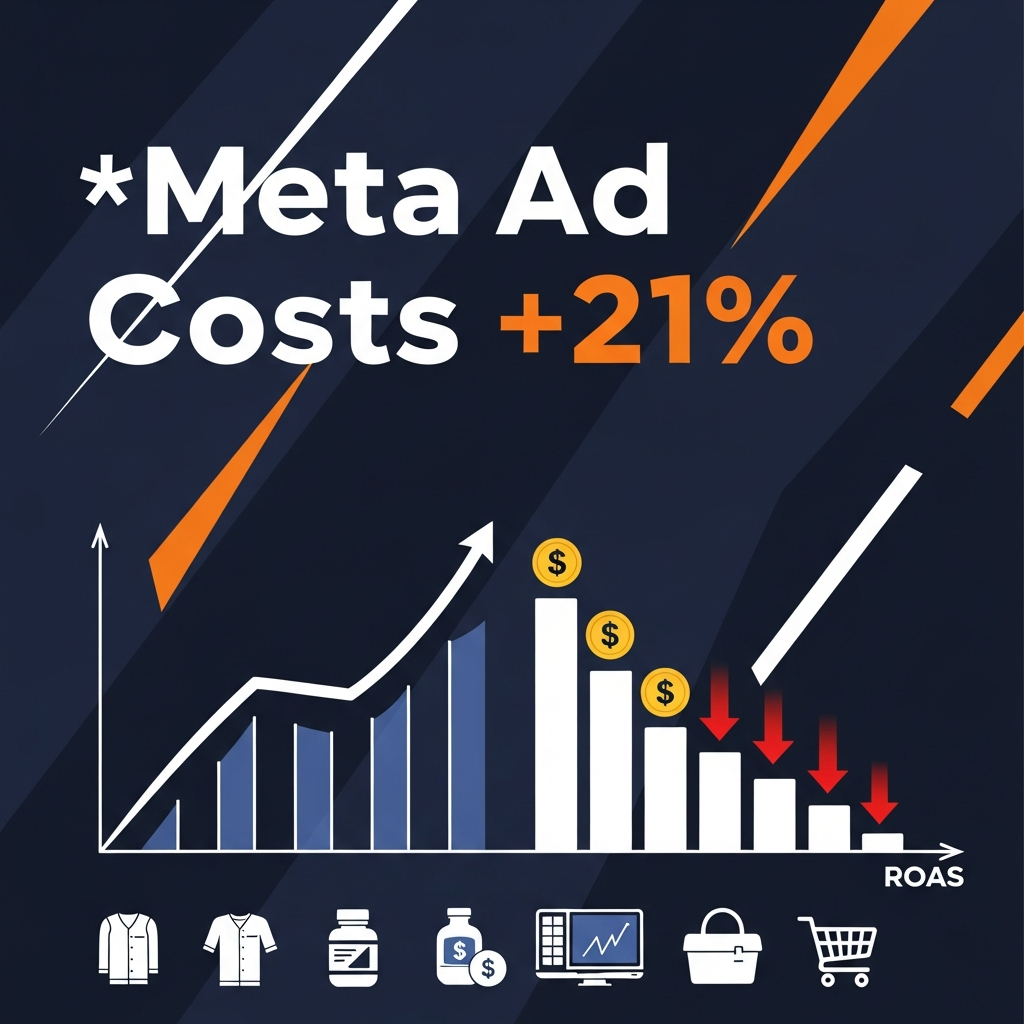
Meta ad costs rising in 2026 isn’t a rumor — it’s the new baseline. CPMs on Meta have climbed approximately 21% year-over-year, and most eCommerce brands are responding the wrong way: absorbing the increase, watching margins compress, and hoping the next creative breaks even.
That’s not a strategy. That’s slow bleed.
The brands staying profitable aren’t doing it by complaining about rising Facebook ad costs or waiting for the platform to settle. They’re making specific structural changes to how they buy, create, convert, and retain. This post walks through exactly what those changes are — and how to implement them before your Q2 numbers get ugly.
Why Meta Ad Costs Are Rising in 2026
Before the fixes, it helps to understand what’s actually driving the CPM increase on Meta Ads.
Three forces are colliding:
1. More advertisers, same inventory
The number of active advertisers on Meta has grown steadily, and competition for high-intent audiences — especially in fashion, beauty, and health — has intensified. More demand, relatively fixed supply of quality impressions = higher auction clearing prices.
2. Privacy-driven signal degradation
iOS changes didn’t disappear. Combined with browser restrictions, third-party cookie deprecation, and evolving consent frameworks, signal quality across the ecosystem has dropped. Meta’s algorithm needs to bid more aggressively to find buyers it’s less certain about — and that uncertainty has a price.
3. Meta’s own monetization push
Meta has been aggressive about expanding ad load and optimizing for platform revenue. Their AI-driven delivery is better at finding buyers than ever before — but “better” comes at a premium. Brands benefitting most from Meta’s AI optimization are paying for that capability through higher CPMs.
The net result: CPM increase on Meta Ads is structural, not cyclical. You’re not going to wait this out.
The Real Damage: What a 21% CPM Increase Actually Costs You
Let’s make this concrete.
If you were spending $50,000/month at a $15 CPM, you were buying ~3.3 million impressions. At a 21% CPM increase, your new CPM is roughly $18.15. Same $50K budget now buys ~2.75 million impressions. You just lost 550,000 impressions — roughly 17% of your reach — without changing anything.
If your CVR and AOV held flat, your ROAS just dropped. Not because your ads got worse. Because the denominator got more expensive.
This is why so many brands saw Meta Ads ROI decline in 2026 without an obvious explanation. The ads didn’t change. The cost structure did.
Now, here’s how to fight back.
7 Strategies Ecommerce Brands Are Using to Stay Profitable
1. Tighten Your Creative Testing Loop
The single highest-leverage response to rising CPMs is improving creative performance — specifically, the speed at which you identify winning ads and cut losers.
Most brands test too slowly. They launch 3–4 new creatives per month, let them run for 3 weeks before deciding, and spend too much budget on underperformers in the interim. At higher CPMs, that dead weight is more expensive than ever.
Here’s what a tighter creative testing loop looks like:
→ Test velocity: 8–12 new creative concepts per month minimum (at $30–50K spend)
→ Decision speed: Make go/no-go calls at $50–100 in spend per ad, not $500
→ Rotation cadence: Expect winning ads to have a 3–5 week shelf life at scale — plan replacements before fatigue hits
→ Learning extraction: After every test cycle, document what worked and why. Hook angle? Proof type? Format? Build on it.
The brands winning on eCommerce Meta Ads profitable benchmarks are treating creative production as a core operational function — not an afterthought. If your current creative cadence feels slow, read our breakdown on why ROAS drops when creative fatigue hits — most of the fixes apply directly here.
2. Fix Post-Click Conversion Rates
Rising CPMs mean you’re paying more to get someone to your site. Every percent increase in your site’s CVR directly offsets that cost increase — without touching your ad budget.
Most eCommerce brands have landing pages converting at 1–2%. The top performers run 3–5%. That delta is worth more than any creative optimization.
High-impact post-click fixes:
→ Message match: Your ad makes a specific promise. Your landing page should open with that exact promise — same offer, same language. If the ad says “30% off your first order,” the LP headline shouldn’t say “Welcome to [Brand].”
→ Social proof at the fold: Reviews, UGC, or trust signals above the scroll line
→ Mobile speed: A 1-second delay in load time can cost 7% in conversions. Check your Core Web Vitals.
→ Checkout friction audit: Remove required account creation, reduce form fields, add buy-now-pay-later options
→ Offer clarity: Can someone understand your offer in 5 seconds? If not, simplify.
A 1% CVR improvement at $50K/month spend more than offsets a 21% CPM increase. This is the most undervalued lever in paid media right now.
If you suspect your landing pages are your real bottleneck, our post on Facebook Ads not converting covers the full diagnostic framework.
3. Consolidate Budget to Top-Performing Audiences
Campaign fragmentation is expensive in normal times. At elevated CPMs, it’s a margin killer.
Here’s what fragmentation looks like: 6–8 ad sets, each targeting different audiences at low individual budgets ($30–50/day each). None of them have enough data for Meta’s algorithm to optimize properly. You’re paying high CPMs to fill underpowered learning phases repeatedly.
The consolidation play:
→ Merge audience testing into fewer, higher-budget ad sets — ideally $100+/day per ad set
→ Let Meta’s Advantage+ audience expansion do more work — broad targeting with strong creative converts better than narrow audiences with weak creative at current CPMs
→ Cut the bottom 20% of campaigns by ROAS weekly — don’t let mediocre ad sets bleed budget
→ Retargeting as a separate budget line — warm audiences still convert at significantly lower CPM than cold
For fashion and swimwear brands specifically, audience consolidation during high-CPM periods is a consistent pattern we’ve seen across accounts. The Meta Ads for Fashion Brands 2026 playbook goes deeper on audience architecture for apparel-specific buyers.
4. Strengthen Signal Quality with CAPI
Here’s where a lot of brands are leaving money on the table: their Meta algorithm is flying half-blind because their conversion signal is weak.
Pixel-only tracking was already degraded after iOS 14. Today, if you’re not running Meta’s Conversions API (CAPI) alongside your pixel — and doing it properly — you’re underreporting conversions by an estimated 15–30%. That means Meta’s algorithm thinks your ads are performing worse than they are, bidding less aggressively for your best buyers, and showing your ads to less qualified audiences.
The fix is CAPI implementation with high event match quality (EMQ). Here’s what that means in practice:
→ Server-side event firing: Your server sends conversion events directly to Meta, bypassing browser/iOS blocking
→ Customer data enrichment: Pass hashed email, phone, and name with every event — this improves match rates from ~40% to 70–80%+
→ Deduplication: Set up proper deduplication between pixel and CAPI to avoid double-counting
→ All conversion events: Don’t just track purchases — fire AddToCart, InitiateCheckout, and ViewContent events to give Meta a complete picture of buyer behavior
Brands that properly implement CAPI typically see 10–25% improvement in reported ROAS — not because performance actually improved, but because they were underreporting before. At elevated CPMs, accurate signal isn’t optional. It’s a competitive advantage.
Check your CAPI setup in Meta Events Manager. If your Event Match Quality score is below 7/10, you have signal leakage that’s directly costing you on CPM.
5. Increase AOV to Protect Margin
If your CPM goes up 21% and your AOV stays flat, your ROAS drops. The math is unavoidable.
But if your CPM goes up 21% and your AOV goes up 20%, the impact is dramatically softened. This is why the most resilient eCommerce brands in a rising-cost environment are AOV-obsessed.
Practical AOV levers:
→ Bundle offers: Create product bundles at a price point 20–30% higher than your core item with a clear value framing (“Save $X vs buying separately”)
→ Post-purchase upsells: Offer a complementary product immediately after checkout at a 10–30% discount — no additional ad spend required
→ Free shipping thresholds: If your average order is $65, set free shipping at $85. Most buyers will add an item.
→ Product page cross-sells: “Frequently bought together” sections on high-traffic PDPs
→ Subscription/replenishment offers: Especially relevant for health and natural product brands — recurring revenue changes your CAC math entirely
A $10 AOV increase in a $50 AOV brand is a 20% revenue lift on the same traffic. Run the numbers against your current CAC and you’ll see why this is one of the highest-ROI moves available to you right now.
6. Shift Focus from CAC to LTV
Most eCommerce brands optimize for CAC. That made sense when CPMs were cheaper and margins were fatter. In a rising-cost environment, CAC optimization alone is a losing game.
The brands winning on Meta Ads ROI in 2026 are optimizing for LTV:CAC ratio — not just acquisition cost.
This shift changes several things:
It changes what you bid. If you know a customer is worth $280 over 12 months but only worth $65 on the first order, you can afford to pay a first-order CPA that looks “too high” on the surface. Brands that only see first-order CAC are voluntarily handicapping their bidding.
It changes what you advertise to returning customers. Email and SMS are dramatically cheaper channels for retaining and re-engaging buyers you already paid to acquire. If you’re spending zero on retention and everything on acquisition, you’re refilling a leaky bucket.
It changes how you evaluate campaigns. Optimizing for first-order ROAS will often kill your best long-term customer acquisition campaigns. Give retention value some weight in your evaluation framework.
If you’re not tracking post-purchase LTV per acquisition channel, that’s where to start. Even rough estimates (30-day LTV, 90-day LTV) change the strategic decisions significantly.
7. Stop Campaign Fragmentation — Consolidate and Let the Algorithm Work
This one overlaps with Strategy 3 but deserves its own emphasis: the biggest tax on performance in a high-CPM environment is resetting learning phases constantly.
Every time you:
- Duplicate an ad set
- Significantly change a budget
- Add/remove audiences mid-flight
- Toggle creatives on/off in a learning-phase campaign
…you’re resetting Meta’s delivery algorithm. In a low-CPM environment, that’s annoying. In a high-CPM environment, it’s expensive.
The discipline here:
→ Fewer, healthier campaigns — don’t run 12 campaigns when 4 would do
→ Make big budget moves gradually — 20% budget increases, not 100% jumps
→ Let winners run until they fatigue — resist the urge to optimize mid-flight
→ Use Campaign Budget Optimization (CBO) — let Meta allocate across ad sets rather than manually capping each one
The goal is to spend as much time as possible in stable, post-learning-phase delivery. That’s where Meta’s algorithm generates consistent, efficient performance. More structure changes = more learning phase resets = higher effective CPM on your best traffic.
What This Looks Like in Practice
These 7 strategies aren’t independent — they compound.
Tighter creative testing finds winners faster → better ads improve CVR → stronger signal from CAPI tells Meta’s algorithm exactly who to find → consolidated campaigns run that algorithm at full efficiency → higher AOV and LTV mean you can afford to bid more aggressively.
The brands that are profitable on Meta right now aren’t just surviving a CPM increase. They’ve built a system that gets more efficient as costs rise — because every layer compounds the one before it.
The brands struggling are running the same playbook they ran in 2023 with 2026 cost structures. That math doesn’t work anymore.
The Bottom Line
Meta ad costs rising in 2026 is the reality. Fighting it by cutting budgets or hoping CPMs come back down is the wrong move. The leverage is in the system — creative velocity, signal quality, post-click conversion, AOV, LTV, and campaign architecture.
Pick the two or three levers above that are most obviously broken in your current setup and fix those first. Don’t try to rebuild everything at once.
If you want an outside perspective on where your account is leaking — whether it’s creative fatigue, CAPI gaps, landing page friction, or campaign structure — that’s exactly what our strategy calls are for.
Book a strategy call here. No pitch, no fluff. Just a clear diagnosis of what’s costing you margin and a prioritized plan to fix it.
Related reading:
ROAS Dropping on Meta Ads? 7 Fixes That Actually Work
Facebook Ads Not Converting in 2026: The Ecommerce Fix
Meta Ads for Fashion Brands: The 2026 Playbook