If your Meta ROAS has quietly dropped over the last few weeks and nothing in your account explains it — same creative, same audiences, same spend — don't start tearing apart your campaigns. The problem might not be your ads at all. It might be your measurement.
Apple's iOS 19 Link Tracking Protection is the most disruptive attribution change since ATT, and most ecommerce brands haven't connected it to the numbers they're staring at. It expanded tracking protection from a Safari-only feature to all cross-app navigation — and the result is a sharp, sudden drop in how many of your conversions Meta can actually see. Your sales may be fine. Your ability to prove they came from Meta is not.
Here's what's happening and how to fix the parts you still control.
What iOS 19 Link Tracking Protection Actually Does
Link Tracking Protection (LTP) isn't new in concept. Apple has been stripping tracking parameters off URLs in Safari and Mail for a while. What changed in iOS 19 is the scope.
Previously, LTP mostly lived inside Safari. You could route around a lot of it because traffic from in-app browsers — like the one that opens when someone taps your ad inside the Facebook or Instagram app — wasn't fully covered.
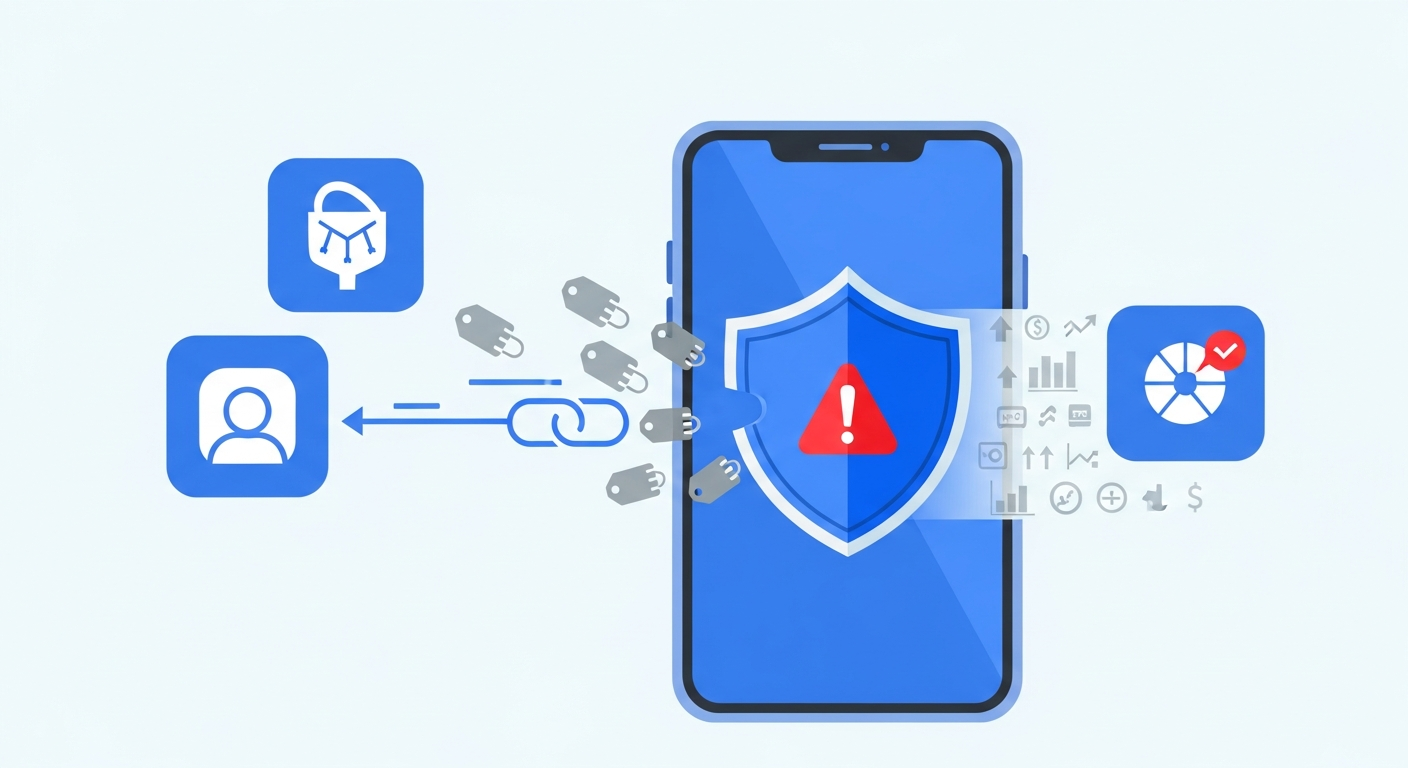
iOS 19 extended Link Tracking Protection to all cross-app navigation. When a user taps a link that sends them from one app to another — say, from Instagram to your store — iOS now strips the tracking parameters off that URL in transit. The click identifiers Meta relies on to tie a sale back to a specific ad get removed before your site ever sees them.
That's the whole game for attribution: those parameters are how the conversion gets matched to the click. Take them away, and the sale still happens — Meta just can't confidently claim it.
The Numbers: This Is Big, Not Marginal
This isn't a rounding error you can shrug off. Stack it on top of an attribution environment that was already deteriorating:
→ ATT opt-in has cratered to around 11% in Q2 2026. Nearly nine out of ten iOS users now decline tracking outright.
→ The Meta Pixel is now capturing only 40–60% of conversions, down from the 85–90% range brands were used to.
→ The net effect is a 35–50% reduction in iOS conversion visibility.
Read those again, because the implication is stark. On iOS — which for many fashion and DTC ecommerce brands is the majority of traffic — Meta might be seeing roughly half of what's actually happening. Half your conversions are becoming invisible to the platform that's optimizing your spend.
Two things follow, and both hurt:
-
Your reported ROAS looks worse than your real ROAS. Sales are occurring that never get credited to Meta. Your dashboard shows a decline that your bank account doesn't.
-
The algorithm is optimizing on partial data. Meta improves delivery by learning from conversions it can see. Feed it half the picture and its targeting and bidding get measurably worse — which means the measurement problem slowly becomes a performance problem too.
Why You Can't Just Wait This Out
Some brands will treat this like every other privacy change — assume Meta will "figure it out" and carry on. That's a mistake. The trajectory is one-directional: Apple keeps tightening, opt-in keeps falling, and pixel-only tracking keeps degrading. There is no version of the next two years where client-side tracking gets better.
The brands that stay profitable are the ones that stop relying on the browser to report their conversions and start sending that data themselves, server to server. That's not a nice-to-have anymore. On iOS, it's the difference between optimizing on 50% of your data and optimizing on most of it.
What Ecommerce Brands Must Fix Now
You can't stop Apple from stripping URLs. You can rebuild the conversion signal through channels Link Tracking Protection doesn't touch. Priority order:
1. Get the Conversions API (CAPI) fully implemented — properly. CAPI sends conversion events from your server directly to Meta, bypassing the browser entirely. Link Tracking Protection strips parameters in the browser; server-side events don't depend on those parameters surviving the trip. A clean CAPI setup is the single biggest recovery lever you have. If you "have CAPI" but it was a half-finished plugin install, that's not enough — it needs complete event coverage and accurate parameters.
2. Maximize event match quality. CAPI only recovers conversions if Meta can match them to a person. Pass strong, hashed customer signals — email, phone, name, location — with every server event. The richer the match data, the more of your lost conversions Meta can reconnect. Brands that ignore match quality leave half of CAPI's value unclaimed.
3. Deduplicate browser and server events. Run pixel and CAPI together with proper event IDs so the same purchase isn't counted twice. Done right, you get the resilience of server-side tracking without inflating your numbers.
4. Anchor decisions to first-party data. Your Shopify (or backend) numbers don't lie — every order is real, regardless of what Meta attributes. Start reconciling platform-reported conversions against your actual store revenue, and weight your scaling decisions toward blended performance and your true cost per acquisition, not Meta's increasingly incomplete in-platform ROAS.
5. Lean on incrementality, not just last-click. As deterministic tracking erodes, the question shifts from "which ad gets the credit?" to "is my Meta spend actually driving incremental sales?" Geo holdouts and spend-based tests give you ground truth the pixel can no longer provide on its own.
The Mindset Shift
Here's the real lesson buried in iOS 19: the era of trusting your ad platform's dashboard as the source of truth is over. Link Tracking Protection didn't just cost you some conversions — it broke the assumption that the number in Ads Manager equals reality.
The operators who win from here run their accounts on two layers. The platform data, degraded but still useful for relative optimization. And their own first-party data — store revenue, true CAC, incrementality tests — as the real scoreboard. When those two disagree, and on iOS they increasingly will, you trust the one Apple can't touch.
Your sales might be perfectly healthy right now. The danger is making cuts based on a dashboard that's blind to half of them. Fix your CAPI, tighten your match quality, and start judging Meta by what your store actually banks — before iOS 19 talks you into killing campaigns that were working all along.
Ready to Scale Your Ecommerce Ads?
If you’re spending $10K+ on Meta ads and want an agency that actually knows ecommerce — book a free strategy call. We’ll audit your account and show you where the growth is.