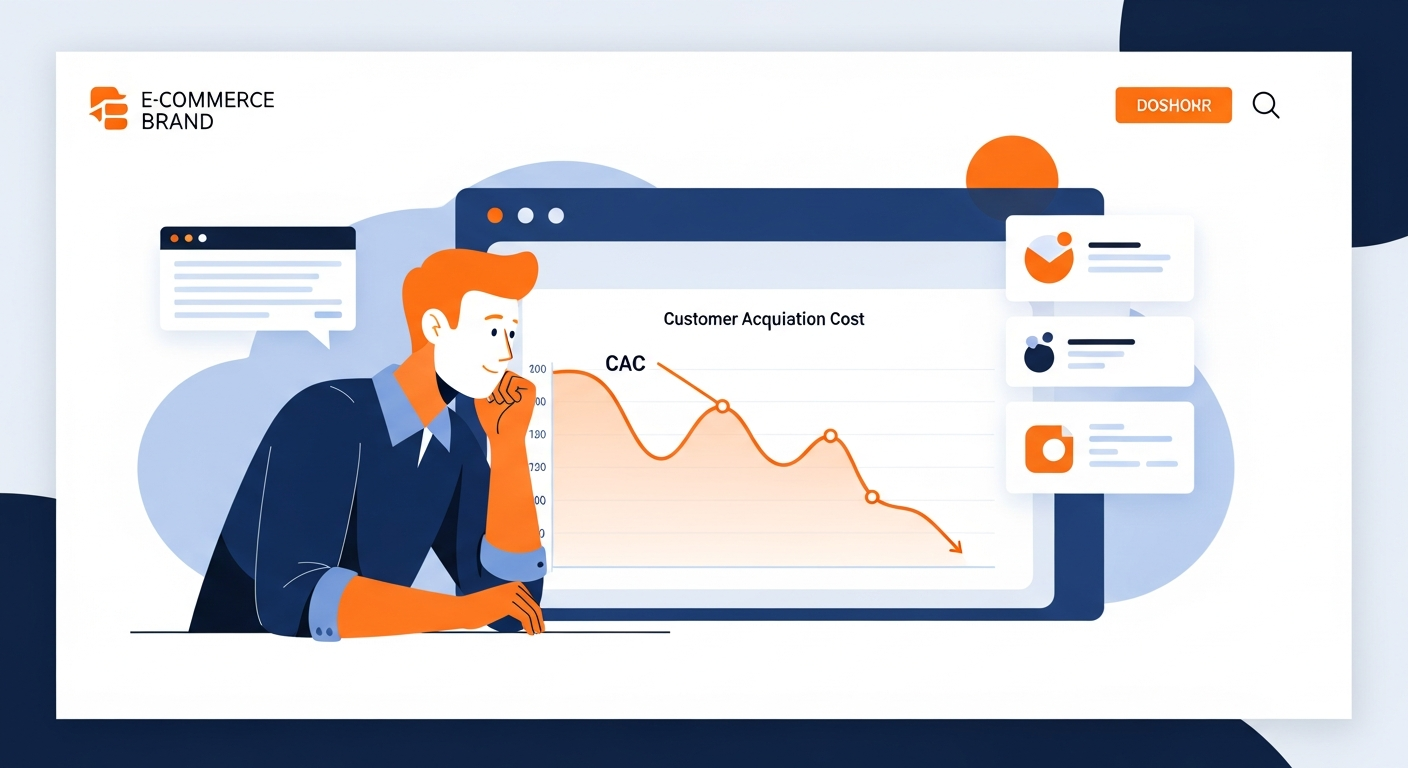
Your Meta Ads CAC is rising. You’ve noticed it — the cost to acquire a customer has crept up month over month, and no matter what you tweak in Ads Manager, it doesn’t seem to stop. Here’s the hard truth: you’re not alone, and it’s not just bad luck.
Customer acquisition costs on Meta have risen approximately 60% over the last five years. That’s not a blip — it’s a structural shift driven by iOS privacy changes, increased advertiser competition, and a platform that’s become significantly more sophisticated (and expensive) to win on.
But brands that understand why CAC rises — and take targeted action — are still achieving efficient acquisition on Meta. This guide breaks down the mechanics, the benchmarks, and the seven proven levers you can pull right now.
Why Your CAC Is Rising on Meta (and Why It’s Not Just the Algorithm)
Every brand blames the algorithm. The algorithm is rarely the primary culprit.
Yes, Meta’s ad auction has become more competitive. Yes, iOS 14.5 created signal loss that cost advertisers meaningful data. Yes, CPMs have risen industrywide. But for most ecommerce brands, CAC is rising because of internal problems that Meta’s system is simply exposing.
Here’s what’s actually happening:
- Creative fatigue accumulates and brands don’t replace creative fast enough. An ad that worked in January often still runs in April — with a fraction of the efficiency.
- Audience targeting has gotten more expensive as more brands chase the same interest-based segments. Narrow audiences create auction competition and inflate CPMs.
- Landing pages haven’t kept pace with ad spend. More budget going to a leaky page just means more expensive leakage.
- Signal loss from iOS hasn’t been addressed. Brands running without Meta’s Conversions API (CAPI) are flying partially blind — and Meta’s algorithm can’t optimize what it can’t see.
The algorithm responds to inputs. If your inputs are degraded — stale creative, poor targeting, weak signal — the algorithm will spend inefficiently and your CAC will climb.
Meta’s 2025–2026 Andromeda update made this even more pronounced. Andromeda shifted Meta toward a more AI-driven, signal-dependent system. Brands with clean data infrastructure are benefiting; brands running legacy setups are paying more for worse results.
The CAC Benchmarks Every Ecommerce Brand Needs to Know
Before you can fix your CAC, you need to know whether it’s actually broken. Benchmarks by vertical:
| Vertical | Average CAC Range | Notes |
|---|---|---|
| Fashion & Apparel | $66–$150 | AOV and repeat purchase rate matter heavily here |
| Swimwear | $75–$130 | Strong seasonality; spring/summer CAC can spike |
| Health & Natural Products | $70–$300 | Wide range; subscription vs. one-time purchase changes the math dramatically |
| Beauty & Skincare | $80–$200 | High competition, strong UGC performance |
These are averages — not targets. A fashion brand with strong retention and a $120 AOV can afford a $90 CAC. A brand with a $45 AOV and no repeat purchase strategy cannot.
The number that actually matters: your break-even CAC. Calculate it as: (Average Order Value × Gross Margin) − Operating Costs per order. If your Meta CAC is above that number, you’re acquiring customers at a loss.
For a deeper look at the unit economics behind this, read our guide on why your Meta Ads ROAS is dropping — the math overlaps significantly.
The 5 Biggest CAC Killers on Meta Ads (and How to Spot Them)
In our experience managing Meta accounts for ecommerce brands doing $500K–$5M+ in revenue, the same five problems drive the majority of inflated CAC:
- Creative fatigue running unchecked. Frequency above 3–4x in cold audiences is a red flag. Watch your CPM trend — rising CPM on flat or falling CTR means Meta is running out of fresh audiences to show your stale ad to.
- Micro-targeting in an era of broad audience efficiency. Interest stacking and narrow custom audiences made sense pre-iOS. Post-iOS, broad targeting with strong creative and clean signal often outperforms over-specified audiences.
- Landing page mismatch. Ad promises a specific product, offer, or outcome — landing page delivers a generic homepage. The CVR tanks, CAC spikes. This is fixable in 48 hours.
- Broken or incomplete conversion tracking. If your pixel is the only signal source and you’re not running CAPI, you’re missing an estimated 20–40% of conversion events post-iOS. Meta under-reports results and over-spends to compensate.
- No retargeting funnel structure. Cold traffic and warm traffic competing in the same campaign with the same bid strategy is a recipe for expensive acquisitions. Warm audiences convert 3–5x better — if they’re properly segmented and served the right message.
To diagnose which of these is your primary issue, pull these metrics in Ads Manager: CPM trend (last 30 days), hook rate (<3 seconds), hold rate (25% video view), CTR (link click), and CVR (landing page). The drop-off point tells you where CAC bleed is happening.
7 Proven Ways to Lower CAC on Meta Ads
1. Fix Creative Fatigue Before It Kills Your CAC
Creative is the single highest-leverage variable in your Meta Ads CAC. Not targeting. Not bidding. Creative.
The typical fashion or DTC brand sees meaningful creative fatigue within 2–4 weeks of launch for a winning concept. The fix isn’t just refreshing the visual — it’s building a creative system:
- Rotate new creative concepts every 2–3 weeks in cold audiences
- Test minimum 3–5 new concepts per month — not variations of the same hook, genuinely new angles
- Monitor hook rate (did they watch 3 seconds?) and hold rate (did they watch 25%?) weekly — these are early warning signs before CTR degrades
- Kill ads when CPM rises >30% from launch baseline with flat CTR — don’t wait for ROAS to collapse
Brands that treat creative as a system — not a one-time output — consistently hold CAC lower than competitors running the same budget.
2. Implement Meta CAPI to Recover Lost Conversions
If you’re not running Meta’s Conversions API (CAPI) alongside your pixel, you are giving the algorithm incomplete data to work with.
Post-iOS 14.5, browser-side pixel tracking misses an estimated 20–40% of purchase events depending on your audience demographics. Meta’s algorithm uses conversion data to optimize delivery — less data means worse optimization, which means higher CAC.
CAPI sends conversion events server-side, bypassing browser-level tracking restrictions. Implementation options:
- Shopify native integration — enable in Meta Business Suite, 30-minute setup
- GTM server-side — more control, requires tech support
- Partner integrations (Triple Whale, Northbeam, etc.) — adds attribution layer on top
Target Event Match Quality (EMQ) score of 7.0+ in Events Manager. Scores below 6 indicate significant data quality issues that are hurting your delivery optimization.
3. Stop Targeting Small, Expensive Audiences
Counter-intuitive but true: in 2025–2026 Meta, broad targeting often outperforms narrow targeting for acquisition campaigns.
Why? Meta’s AI (including the Andromeda system) has enough behavioral data to find your buyers within a broad audience — especially when you give it strong creative signals and clean conversion data. When you constrain the audience with interest stacks and exclusions, you’re paying a CPM premium to override a system that frequently knows better.
What to test:
- Advantage+ audience with minimal restrictions vs. your current interest-based targeting
- Broad (18–45, US, no interests) vs. your best interest stack
- Let each run 7–10 days with enough budget for 30–50 conversions before evaluating
Many brands find that removing targeting constraints drops CPM 15–25% while maintaining or improving CVR — net CAC improvement without changing creative at all.
4. Improve Your Post-Click Experience
The cheapest clicks in the world don’t matter if your landing page doesn’t convert. And yet most Meta ad audits we run reveal that landing page is the primary CAC culprit — not the ads.
The most common landing page CAC killers:
- Message mismatch — ad promises a specific product or offer; landing page is generic
- Mobile load speed — pages loading in >3 seconds lose a significant share of mobile visitors before the page even loads
- Weak above-the-fold value proposition — first 2 seconds need to confirm the ad’s promise, not make people hunt for it
- Friction in the purchase flow — too many steps, forced account creation, confusing checkout
Quick audit: check your CVR by device in GA4. If mobile CVR is dramatically lower than desktop (more than 2:1 gap), you have a mobile experience problem that’s inflating your blended CAC.
5. Use Partnership Ads and UGC to Lower CPM
This is one of the most underused levers in ecommerce Meta strategy right now.
Meta Partnership Ads (formerly Branded Content Ads) allow you to run ads from a creator’s or partner’s account handle — with your targeting and budget. The performance difference is significant: partnership ads generate up to 53% higher CTR compared to standard brand ads, driven by the trust signal of a third-party account and the native feel of creator content.
Lower CTR costs and higher engagement rates translate directly to lower CPMs — which directly lowers CAC.
UGC (user-generated content) follows the same logic. Authentic product reviews, unboxings, and lifestyle content filmed on phones consistently outperform high-production brand creative for cold audience acquisition. The gap has widened in 2025–2026 as platform users have become more ad-aware.
Tactical approach: source 3–5 UGC creators per quarter, test their content in cold audiences against your polished creative, and let the data tell you what wins.
6. Increase AOV to Make Your CAC Profitable
Here’s something most brands overlook: you don’t always need to lower your CAC — sometimes you need to raise what each customer is worth.
If your CAC is $80 and your AOV is $60, no amount of Meta optimization will save you. But if you get AOV to $95 through bundling, you’ve turned a losing CAC into a profitable one — without touching a single ad.
AOV levers worth testing:
- Product bundles — combine complementary products at a slight discount to increase order size
- Volume discounts — “buy 2, save 10%” is simple and effective for consumables and accessories
- Post-add-to-cart upsells — apps like ReConvert and CartHook can add 10–20% to AOV
- Free shipping thresholds set above average order value — customers often add products to qualify
A $15–$20 increase in AOV at the same CAC can be the difference between a profitable channel and a money pit.
7. Build a Proper Retargeting Funnel
Running cold and warm audiences in the same campaign with the same creative is one of the most expensive mistakes in Meta Ads.
Warm audiences (website visitors, add-to-carts, video viewers, email list) convert at 3–5x the rate of cold audiences. They deserve their own creative, their own messaging, and their own budget allocation — not to compete in a mixed auction that dilutes your best buyers.
A functional retargeting structure:
- Top of funnel (cold): New audiences, awareness creative, broad targeting, brand story
- Middle of funnel (warm): Website visitors (30 days), video viewers (75%+), social engagers — serve proof-based content: reviews, testimonials, comparisons
- Bottom of funnel (hot): Add-to-carts and initiate checkouts (7–14 days) — dynamic product ads, urgency creative, offer close
Segment these with exclusions. If your BOF audience sees your TOF creative, you’re wasting warm intent on a cold message.
How to Track and Monitor Your CAC (the Right Way)
Most brands track CAC wrong — pulling it from Meta’s reported cost-per-purchase and calling it done. That number is inflated by attribution overlap and deflated by last-touch attribution bias. Neither version gives you a clean picture.
True CAC formula:
True CAC = Total Meta Ad Spend ÷ New Customers Acquired (not total purchases)
This means you need to be able to separate new customer purchases from returning customer purchases — either through your Shopify analytics (first-time vs. returning customer filter), your attribution tool, or GA4 with proper user segmentation.
Metrics to review weekly:
- CPM trend — rising CPM is early warning of creative fatigue or audience saturation
- Hook rate — if <30% of impressions result in 3-second views, your opening is failing
- Hold rate — if 25% video view rate is declining, your content isn’t holding attention
- Link CTR — industry benchmark 1–2% for cold audiences; below 0.8% is a signal to investigate
- CVR (post-click) — if this drops while ad metrics hold steady, the problem is on your site
- Blended new customer CAC — the north star metric that ties it all together
Build a weekly dashboard with these six numbers. CAC optimization is pattern recognition over time — you can’t spot patterns without consistent data collection.
When to Call It: Signs Your CAC Is Unfixable Without a Full Rebuild
Not every underperforming Meta account can be optimized. Sometimes the structure, history, or setup is so degraded that iteration on the existing account will yield diminishing returns. Signs you’re there:
- Account learning has never stabilized — campaigns constantly in “Learning Limited” despite adequate budget
- Conversion tracking is fundamentally broken — event match quality below 5, pixel misfire, duplicate events — and has been for 6+ months
- Historical data is poisoned by bad structure — years of campaign changes, pixel resets, and budget swings create a signal history Meta can’t effectively build on
- CAC is 3x+ break-even with no clear diagnostic explanation — when you’ve addressed creative, targeting, landing page, and tracking and CAC still won’t move, the account may need a clean start
- Ad account flags or restrictions that are limiting delivery without resolution
A full rebuild — new ad account, clean pixel, properly structured CAPI, fresh creative from zero — is sometimes the faster path to a profitable CAC than trying to fix a broken foundation.
This isn’t a decision to make lightly, but it’s a decision that experienced Meta buyers make when the data demands it.
Ready to Lower Your Meta Ads CAC? Let’s Talk Strategy.
If your CAC is trending the wrong direction and you want a clear diagnosis — not a generic checklist — we can help. Dash Activate Online specializes in Meta Ads performance for ecommerce brands in fashion, swimwear, and health products.
We’ll audit your account, identify your top CAC killers, and give you a prioritized action plan — no fluff, no agency speak.