Most ecommerce brands hit the same wall with their Facebook ads creative strategy: the agency runs out of ideas by month three.
The first few weeks feel productive. Fresh eyes on your account, new angles getting tested, early wins that make everyone feel smart. But then something shifts. The winning ads start fatiguing. The new concepts start sounding like variations of the old ones. And suddenly your agency is recycling the same three hooks with different thumbnails.
I have seen it happen to good agencies with talented people. The problem is not laziness — it is something deeper that nobody wants to talk about.
Why Traditional Facebook Ads Creative Research Fails
Here is what most agencies will not admit: manual research CAN scale. You can hire more people, dedicate more hours, build bigger swipe files. But there is a problem that does not go away with more resources.
Strategists have biases.
Once we see something working, we are less inclined to step away from it. Why would we? It is performing. The client is happy. Injecting uncertainty into an ad account that is hitting targets feels like unnecessary risk.
So we optimize what is working instead of questioning whether something else might work better. We dig deeper into the same angle instead of exploring adjacent territory. We become experts in a narrow lane while the broader landscape shifts around us.
This is tunnel vision, and every experienced media buyer has it. Not because they are bad at their job — because they are human. Pattern recognition is how we survive. But it is also how we miss the patterns we are not looking for.
The question is not whether your agency has blind spots. It is whether they have a system for finding them.
Building an Always-On Ecommerce Ad Creative Strategy Engine
About a year ago, we started experimenting with AI-assisted research. Not to replace human judgment — that is still where the real creative decisions happen — but to break us out of our own tunnel vision.
The AI does not care what worked last month. It does not have a favorite angle. It does not feel the pull to protect what is already performing. It just surfaces signals — and forces us to look at things we thought we already knew inside out.
Here is what our ecommerce ad creative strategy system looks like now:
Continuous Multi-Source Monitoring
We have automated systems scanning Reddit threads, customer reviews, competitor content, Google Trends, and social conversations daily. Not just for our clients brands, but for their entire category. When someone posts a frustrated rant about why they switched products, when a YouTube reviewer mentions an unexpected use case, when a Reddit thread surfaces a pain point we had never considered — we see it.
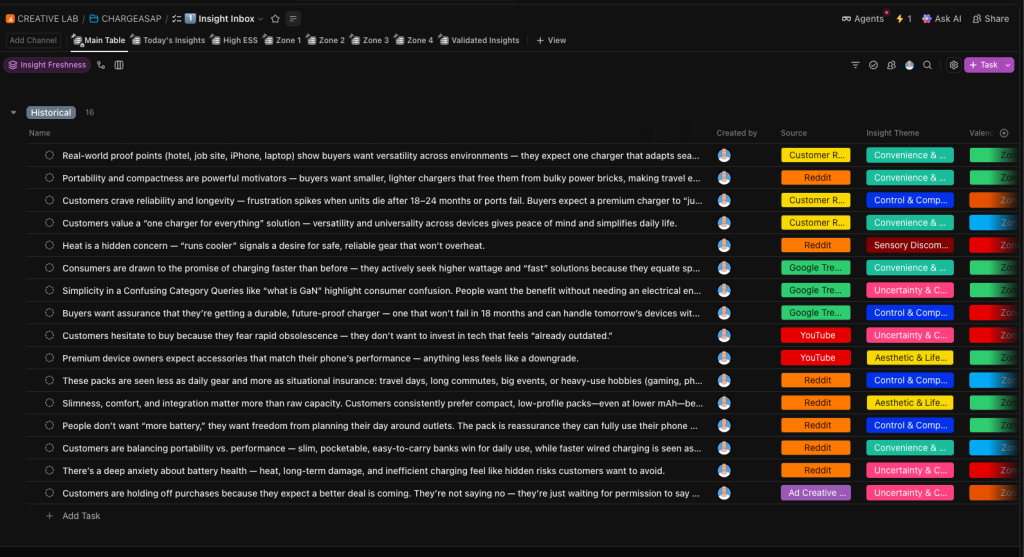
Organized Insight Inbox
Every potential insight gets captured and categorized: the source it came from (Reddit, customer reviews, Google Trends, competitor ad analysis), the emotional theme it touches (convenience, control, uncertainty, sensory experience), and an initial assessment of its potential. We are not drowning in noise — we are systematically processing signal.
Pattern Recognition at Scale
The AI identifies clusters we would miss manually. Recurring objections across multiple sources. Emotional language patterns that indicate high purchase intent. The specific words customers use when they are ready to buy versus when they are just browsing. It can process hundreds of data points and surface connections that would take a human researcher weeks to find.
Bias-Breaking by Design
Here is the key: the system is designed to challenge our assumptions. Seasonality shifts, social commentary, current events — all of these get factored in automatically. When the AI surfaces an insight that contradicts our current Meta ads creative testing strategy, we cannot ignore it. It forces us to re-examine what we think we know.
How This Facebook Ads Creative Research Process Works in Practice
Let me give you a real example.
We had a client selling premium tech accessories. Standard marketing: sleek product shots, feature comparisons, the usual. Performance was decent but plateaued.
Our research engine flagged something we would never have caught manually: a cluster of conversations where customers were expressing anxiety about heat and long-term device damage from charging. Not about speed. Not about portability. About safety and reliability.
That insight came from cross-referencing Reddit discussions, customer reviews mentioning runs cooler and Google Trends showing rising searches around charging safety. No single source would have surfaced it clearly — but the pattern across sources was undeniable.
We built a campaign around that angle. Same product, completely different emotional entry point. It outperformed our previous best by 40%.
Would we have found that manually? Maybe eventually. But here is the truth: we were not even looking for it. Our tunnel vision had us focused on speed and convenience because that is what the category always talks about. The AI did not have that bias.
The Compounding Advantage of Systematic Creative Research
Here is what most people miss about systematic Facebook ads creative research: it compounds.
Every insight you test generates data. That data refines your understanding of what resonates. That understanding makes your next hypothesis better. Over months, you are not just running ads — you are building a proprietary map of what makes your customers act.
We track every insight through the full cycle: from discovery to testing to validation. The ones that perform become part of our knowledge base. The ones that do not teach us what to avoid. Either way, we are learning — systematically, not randomly.
Agencies that rely on gut instinct and occasional research sprints cannot build this. They are always starting from scratch, always hoping the next idea is a winner. They are not building — they are guessing.
We are building a system that gets smarter every week.
The Human Layer Still Matters
I want to be clear: AI does not write our ads. It does not pick the winners. It does not replace the strategic judgment that comes from years of running ecommerce campaigns.
What it does is expand what is possible. It lets a small team cover ground that used to require an army of researchers. It surfaces signals we would otherwise miss. It breaks us out of the tunnel vision that comes naturally to anyone who has been in an account for months.
The actual creative decisions — which angles to pursue, how to frame the message, what tone resonates with this specific audience — those are still human calls. The AI just makes sure we are making those calls with better information and fewer blind spots.
Think of it like this: the AI gives us superhuman research capacity. But the strategy is still deeply human.
What This Means for Your Ecommerce Brand
If you are working with an agency that is still doing creative research the old way – occasional audits, competitor scrolls, maybe some review mining when they have time – you are leaving angles on the table.
Worse, you are probably stuck in their tunnel vision. They found something that works, so they are optimizing it instead of questioning it. Meanwhile, your customers are having conversations about pain points and desires that never make it into your creative brief.
The brands winning in 2026 are the ones treating their ecommerce ad creative strategy as a system, not an event. They are building compounding advantage while competitors keep recycling the same angles until they stop working.
We have spent the last year building this research engine. It is not magic — it is just systematic where others are sporadic, and bias-aware where others are blind.
If you want to see what your customers are actually saying and what your competitors are missing, let us talk.